
Advanced Optimizer Control: Diversity, Fitness Sharing, and Local Search
When default settings produce premature convergence or poor search quality, these controls give you finer-grained command over the evolutionary process. They are optional — the defaults are conservative and work well for most searches. Add them one at a time when telemetry shows the optimizer needs them.
Prerequisites
- Completed Basic Usage
- Familiar with Understanding Cross-Validation
When to Use These Controls
Check pd.DataFrame(search.history) after a run. Add controls if you see:
| Symptom | Likely cause | Remedy |
|---|---|---|
unique_individual_ratio drops to near 0 in a few generations | Population collapsed | Enable diversity_control |
genotype_diversity is low while score still improves | Slow convergence, not stuck | Let it run or increase population_size |
stagnation_generations grows for 5+ generations | Local optimum | Enable diversity_control, fitness sharing, or local search |
| Multiple high-scoring but similar candidates | Single dominant region | Enable fitness_sharing to keep multiple niches alive |
| Final solution is good but nearby configs might be better | Under-exploited region | Enable local_search |
Configuration Objects
Advanced settings live in OptimizationConfig. All parameters are disabled (or set to low-impact defaults) unless explicitly changed.
from sklearn_genetic import OptimizationConfigFull Example: Hyperparameter Search
import numpy as np
import pandas as pd
from sklearn.datasets import load_breast_cancer
from sklearn.ensemble import RandomForestClassifier
from sklearn.metrics import accuracy_score, roc_auc_score
from sklearn.model_selection import StratifiedKFold, train_test_split

from sklearn_genetic import (
    EvolutionConfig,
    GASearchCV,
    OptimizationConfig,
    PopulationConfig,
    RuntimeConfig,
)
from sklearn_genetic.plots import plot_diversity, plot_optimizer_events
from sklearn_genetic.schedules import ExponentialAdapter, InverseAdapter
from sklearn_genetic.space import Categorical, Integer

X, y = load_breast_cancer(return_X_y=True)
X_train, X_test, y_train, y_test = train_test_split(
    X, y, test_size=0.25, stratify=y, random_state=42
)

cv = StratifiedKFold(n_splits=4, shuffle=True, random_state=42)

param_grid = {
    "n_estimators": Integer(50, 250),
    "max_depth": Integer(2, 20),
    "min_samples_split": Integer(2, 20),
    "min_samples_leaf": Integer(1, 10),
    "max_features": Categorical(["sqrt", "log2", None]),
    "criterion": Categorical(["gini", "entropy", "log_loss"]),
}

crossover_schedule = InverseAdapter(
    initial_value=0.8,
    end_value=0.6,
    adaptive_rate=0.05,
)
mutation_schedule = ExponentialAdapter(
    initial_value=0.1,
    end_value=0.25,
    adaptive_rate=0.08,
)

search = GASearchCV(
    estimator=RandomForestClassifier(random_state=42, n_jobs=1),
    random_state=42,
    param_grid=param_grid,
    cv=cv,
    scoring="roc_auc",
    evolution_config=EvolutionConfig(
        population_size=24,
        generations=18,
        crossover_probability=crossover_schedule,
        mutation_probability=mutation_schedule,
        tournament_size=3,
        elitism=True,
        keep_top_k=4,
    ),
    population_config=PopulationConfig(initializer="smart"),
    runtime_config=RuntimeConfig(n_jobs=-1, parallel_backend="auto", verbose=True),
    optimization_config=OptimizationConfig(
        # Diversity control
        diversity_control=True,
        diversity_threshold=0.18,
        diversity_stagnation_generations=4,
        diversity_mutation_boost=1.8,
        random_immigrants_fraction=0.15,
        # Fitness sharing
        fitness_sharing=True,
        sharing_radius=0.25,
        sharing_alpha=1.0,
        # Local search
        local_search=True,
        local_search_top_k=2,
        local_search_steps=4,
        local_search_radius=0.08,
    ),
)

search.fit(X_train, y_train)

y_pred = search.predict(X_test)
y_proba = search.predict_proba(X_test)[:, 1]

print(search.best_params_)
print("Accuracy:", accuracy_score(y_test, y_pred))
print("ROC AUC:", roc_auc_score(y_test, y_proba))
Reading Optimizer Telemetry
After fitting, convert history to a DataFrame to diagnose the search:
history = pd.DataFrame(search.history)

columns = [
    "gen",
    "fitness_best",
    "fitness_max",
    "unique_individual_ratio",
    "genotype_diversity",
    "stagnation_generations",
    "mutation_probability",
    "diversity_control_triggered",
    "random_immigrants",
    "duplicate_replacements",
    "fitness_sharing_applied",
    "mean_niche_count",
    "max_niche_count",
    "local_refinements",
]

print(history[columns])
print(search.fit_stats_)
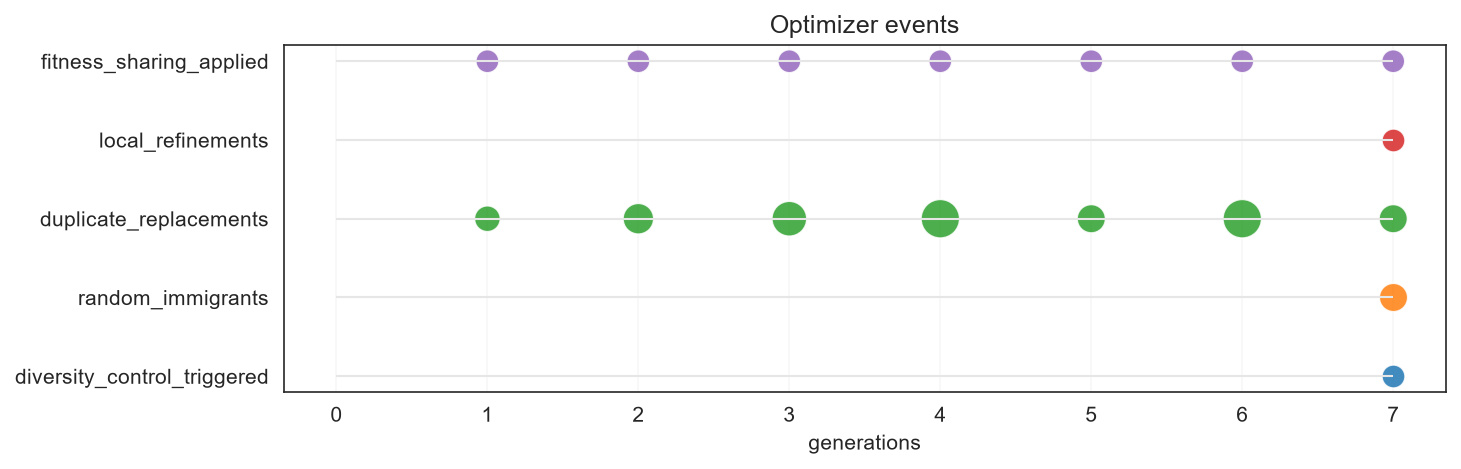
The same telemetry is easier to reason about visually. plot_diversity shows whether the population collapsed or recovered, while plot_optimizer_events marks the generations where diversity control, immigrant injection, sharing, or local search changed the search process.
import matplotlib.pyplot as plt

plot_diversity(search)
plt.show()

plot_optimizer_events(search)
plt.show()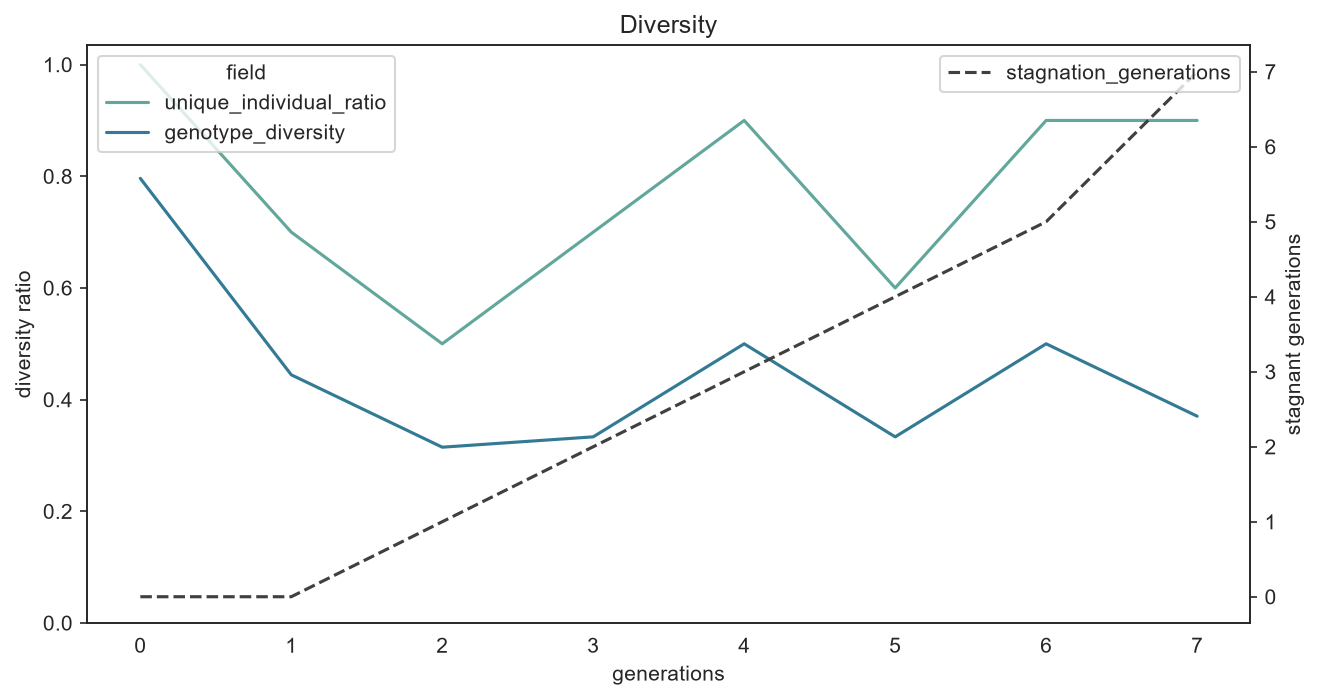
Key telemetry fields:
| Field | Meaning |
|---|---|
unique_individual_ratio | Fraction of distinct individuals. Low → population collapsed |
genotype_diversity | Average per-gene diversity. Low → structurally similar candidates |
stagnation_generations | Generations since fitness_best last improved |
diversity_control_triggered | Whether diversity control fired this generation |
random_immigrants | Number of random candidates injected |
duplicate_replacements | Duplicate offspring replaced before evaluation |
fitness_sharing_applied | Whether niche-aware selection was active |
mean_niche_count / max_niche_count | Crowding during selection |
local_refinements | Neighbor candidates evaluated by local search (usually non-zero only in the final row) |
Feature Selection Example
The same controls work with GAFeatureSelectionCV. In feature selection, local_search_radius controls the fraction of feature bits flipped when creating local neighbors.
from sklearn.datasets import load_breast_cancer
from sklearn.ensemble import RandomForestClassifier
from sklearn.model_selection import StratifiedKFold, train_test_split

from sklearn_genetic import (
    EvolutionConfig,
    GAFeatureSelectionCV,
    OptimizationConfig,
    PopulationConfig,
    RuntimeConfig,
)
from sklearn_genetic.schedules import ExponentialAdapter

X, y = load_breast_cancer(return_X_y=True)
X_train, X_test, y_train, y_test = train_test_split(
    X, y, test_size=0.25, stratify=y, random_state=42
)

cv = StratifiedKFold(n_splits=4, shuffle=True, random_state=42)

selector = GAFeatureSelectionCV(
    estimator=RandomForestClassifier(random_state=42, n_jobs=1),
    random_state=42,
    cv=cv,
    scoring="roc_auc",
    max_features=18,
    evolution_config=EvolutionConfig(
        population_size=30,
        generations=16,
        crossover_probability=0.8,
        mutation_probability=ExponentialAdapter(
            initial_value=0.1, end_value=0.25, adaptive_rate=0.08
        ),
        keep_top_k=4,
    ),
    population_config=PopulationConfig(initializer="smart"),
    runtime_config=RuntimeConfig(n_jobs=-1, parallel_backend="auto", verbose=True),
    optimization_config=OptimizationConfig(
        diversity_control=True,
        diversity_threshold=0.2,
        diversity_stagnation_generations=4,
        random_immigrants_fraction=0.15,
        fitness_sharing=True,
        sharing_radius=0.2,
        local_search=True,
        local_search_top_k=2,
        local_search_steps=5,
        local_search_radius=0.1,
    ),
)

selector.fit(X_train, y_train)

print("Selected features:", selector.best_features_)
print("Test score:", selector.score(X_test, y_test))
Recommended Workflow
Start simple and add controls based on telemetry:
- Default run — use
PopulationConfig(initializer="smart"),crossover_probability=0.8,mutation_probability=0.1. Inspect history. - If diversity collapses early — enable
OptimizationConfig(diversity_control=True). - If one candidate family dominates — enable
fitness_sharing=True. - If the final region looks close but not fully refined — enable
local_search=True. - If stagnation persists — add adaptive schedules: slowly increase mutation over generations.
Tuning Guidelines
| Parameter | Practical starting range | Notes |
|---|---|---|
diversity_threshold | 0.1–0.3 | Higher triggers earlier |
diversity_mutation_boost | 1.5–2.5 | Too high = next generation is random |
random_immigrants_fraction | 0.05–0.2 | Larger helps rugged spaces; may slow convergence |
sharing_radius | 0.15–0.35 | Smaller = only penalize very similar candidates |
local_search_radius | 0.05–0.15 | Larger = behaves more like an extra mutation phase |
local_search_steps | 1–5 | Each step = extra CV calls |
Practical Notes
- Fitness sharing only changes temporary selection pressure; it does not alter
best_score_,cv_results_, or raw cross-validation scores. - Local search evaluates extra candidates after the genetic search completes, so it can improve final quality but increases total runtime.
- Always keep a final holdout set separate from the CV folds for honest model assessment.
Next Steps
- Adaptive Schedules — schedule mutation and crossover rates over generations
- Troubleshooting — diagnose convergence problems using
fit_stats_andhistory - Config Objects API — full parameter reference for
OptimizationConfig
Cheaper search with full-training finalist validation
Both searches can explore using fewer training rows per CV fold, then re-evaluate a small number of distinct finalists on the original folds. subsample_cv changes only the training indices; every validation row stays in place. The evolutionary operators continue to select and generate candidates using these cheaper scores.
Use a separate outer test set to measure whether the speed/quality tradeoff suits your data:
from sklearn.base import clone
from sklearn.datasets import load_breast_cancer
from sklearn.model_selection import StratifiedKFold, train_test_split
from sklearn.pipeline import make_pipeline
from sklearn.preprocessing import StandardScaler
from sklearn.svm import SVC
from sklearn_genetic import GASearchCV, GAFeatureSelectionCV, subsample_cv
from sklearn_genetic.space import Continuous

X, y = load_breast_cancer(return_X_y=True)
X_train, X_test, y_train, y_test = train_test_split(
    X, y, test_size=0.25, stratify=y, random_state=42
)
full_cv = list(StratifiedKFold(3, shuffle=True, random_state=42).split(X_train, y_train))
search_cv = subsample_cv(full_cv, 0.25, stratify=y_train, random_state=42)
model = make_pipeline(StandardScaler(), SVC())
common = dict(
    cv=search_cv,
    scoring="accuracy",
    population_size=8,
    generations=4,
    random_state=42,
    n_jobs=1,
    verbose=False,
    final_selection=True,
    final_selection_top_k=4,
    final_selection_cv=full_cv,
)
hpo = GASearchCV(
    clone(model),
    param_grid={
        "svc__C": Continuous(0.01, 1000, distribution="log-uniform"),
        "svc__gamma": Continuous(0.0001, 1, distribution="log-uniform"),
    },
    **common,
).fit(X_train, y_train)
features = GAFeatureSelectionCV(clone(model), **common).fit(X_train, y_train)
print(hpo.best_score_, hpo.score(X_test, y_test))
print(features.best_score_, features.score(X_test, y_test), features.support_.sum())
For models where each fold is expensive, another option is to replace the subsample_cv(...) line with search_cv = full_cv[:1] and set final_selection_top_k=8 in common. The search then scores candidates on one original fold and validates the eight best distinct candidates on all three folds. This can save more time than shortening each training fold, but preliminary rankings use less validation data and can miss the best candidate. In a six-split five-fold SVC benchmark, this pattern made HPO 4.09–4.81× faster with a mean accuracy loss of 0.00583 on synthetic data. Feature selection was 3.48–3.92× faster but lost mean accuracy on all three datasets. Expanding from eight to 24 finalists did not consistently recover quality. Compare held-out accuracy and the complete fitting time on your own data before choosing either shortcut.
cv_results_, history and the hall of fame retain the original search scores and candidates. final_selection_results_ records each promoted candidate's original and final scores, full-validation fold scores, the winner and validation time. best_score_ describes the final-validation winner, so it need not equal a value in cv_results_. Feature selection breaks equal final scores by preferring fewer columns. Invalid NaN finalists cannot replace valid candidates; if every finalist score is NaN, fitting raises an error.
Final selection runs with refit=True. Its extra CV evaluations and final refit are additional to the evolutionary budget; generation stopping callbacks do not cap those stages. Include them when timing a workflow. An explicit non-None final_selection_cv overrides the corresponding OptimizationConfig value. Both settings and explicit fold arrays survive cloning and checkpoints.
Use stratify=y_train for classification, and omit it for regression. Sampling that drops a class raises an error; increase the fraction in that case. The discarded rows do not need to contain every class. A fraction of 1 keeps the original training folds. This is opt-in: ordinary searches still use full training folds. Smaller training sets can change candidate rankings, and full validation of finalists cannot recover a good candidate discarded earlier. Measure held-out quality and total time; small datasets or models with high fixed training cost may gain little.