
Advanced Optimizer Control: Diversity, Fitness Sharing, and Local Search
When default settings produce premature convergence or poor search quality, these controls give you finer-grained command over the evolutionary process. They are optional — the defaults are conservative and work well for most searches. Add them one at a time when telemetry shows the optimizer needs them.
Diversity-driven variation, fitness sharing, random immigrants and local refinement in this guide apply to DEAP. Shared telemetry and finalist selection also work with the other optimizer backends.
Prerequisites
- Completed Basic Usage
- Familiar with Understanding Cross-Validation
When to Use These Controls
Check pd.DataFrame(search.history) after a run. Add controls if you see:
| Symptom | Likely cause | Remedy |
|---|---|---|
unique_individual_ratio drops to near 0 in a few generations | Population collapsed | Enable diversity_control |
genotype_diversity is low while score still improves | Slow convergence, not stuck | Let it run or increase population_size |
stagnation_generations grows for 5+ generations | Local optimum | Enable diversity_control, fitness sharing, or local search |
| Multiple high-scoring but similar candidates | Single dominant region | Enable fitness_sharing to keep multiple niches alive |
| Final solution is good but nearby configs might be better | Under-exploited region | Enable local_search |
Configuration Objects
Advanced settings live in OptimizationConfig. All parameters are disabled (or set to low-impact defaults) unless explicitly changed.
from sklearn_genetic import OptimizationConfigFull Example: Hyperparameter Search
import numpy as np
import pandas as pd
from sklearn.datasets import load_breast_cancer
from sklearn.ensemble import RandomForestClassifier
from sklearn.metrics import accuracy_score, roc_auc_score
from sklearn.model_selection import StratifiedKFold, train_test_split

from sklearn_genetic import (
    EvolutionConfig,
    GASearchCV,
    OptimizationConfig,
    PopulationConfig,
    RuntimeConfig,
)
from sklearn_genetic.plots import plot_diversity, plot_optimizer_events
from sklearn_genetic.schedules import ExponentialAdapter, InverseAdapter
from sklearn_genetic.space import Categorical, Integer

X, y = load_breast_cancer(return_X_y=True)
X_train, X_test, y_train, y_test = train_test_split(
    X, y, test_size=0.25, stratify=y, random_state=42
)

cv = StratifiedKFold(n_splits=4, shuffle=True, random_state=42)

param_grid = {
    "n_estimators": Integer(50, 250),
    "max_depth": Integer(2, 20),
    "min_samples_split": Integer(2, 20),
    "min_samples_leaf": Integer(1, 10),
    "max_features": Categorical(["sqrt", "log2", None]),
    "criterion": Categorical(["gini", "entropy", "log_loss"]),
}

crossover_schedule = InverseAdapter(
    initial_value=0.8,
    end_value=0.6,
    adaptive_rate=0.05,
)
mutation_schedule = ExponentialAdapter(
    initial_value=0.1,
    end_value=0.25,
    adaptive_rate=0.08,
)

search = GASearchCV(
    estimator=RandomForestClassifier(random_state=42, n_jobs=1),
    random_state=42,
    param_grid=param_grid,
    cv=cv,
    scoring="roc_auc",
    evolution_config=EvolutionConfig(
        population_size=24,
        generations=18,
        crossover_probability=crossover_schedule,
        mutation_probability=mutation_schedule,
        tournament_size=3,
        elitism=True,
        keep_top_k=4,
    ),
    population_config=PopulationConfig(initializer="smart"),
    runtime_config=RuntimeConfig(n_jobs=-1, parallel_backend="auto", verbose=True),
    optimization_config=OptimizationConfig(
        # Diversity control
        diversity_control=True,
        diversity_threshold=0.18,
        diversity_stagnation_generations=4,
        diversity_mutation_boost=1.8,
        random_immigrants_fraction=0.15,
        # Fitness sharing
        fitness_sharing=True,
        sharing_radius=0.25,
        sharing_alpha=1.0,
        # Local search
        local_search=True,
        local_search_top_k=2,
        local_search_steps=4,
        local_search_radius=0.08,
    ),
)

search.fit(X_train, y_train)

y_pred = search.predict(X_test)
y_proba = search.predict_proba(X_test)[:, 1]

print(search.best_params_)
print("Accuracy:", accuracy_score(y_test, y_pred))
print("ROC AUC:", roc_auc_score(y_test, y_proba))
Reading Optimizer Telemetry
After fitting, convert history to a DataFrame to diagnose the search:
history = pd.DataFrame(search.history)

columns = [
    "gen",
    "fitness_best",
    "fitness_max",
    "unique_individual_ratio",
    "genotype_diversity",
    "stagnation_generations",
    "mutation_probability",
    "diversity_control_triggered",
    "random_immigrants",
    "duplicate_replacements",
    "fitness_sharing_applied",
    "mean_niche_count",
    "max_niche_count",
    "local_refinements",
]

print(history[columns])
print(search.fit_stats_)
The same telemetry is easier to reason about visually. plot_diversity shows whether the population collapsed or recovered, while plot_optimizer_events marks the generations where diversity control, immigrant injection, sharing, or local search changed the search process.
import matplotlib.pyplot as plt

plot_diversity(search)
plt.show()

plot_optimizer_events(search)
plt.show()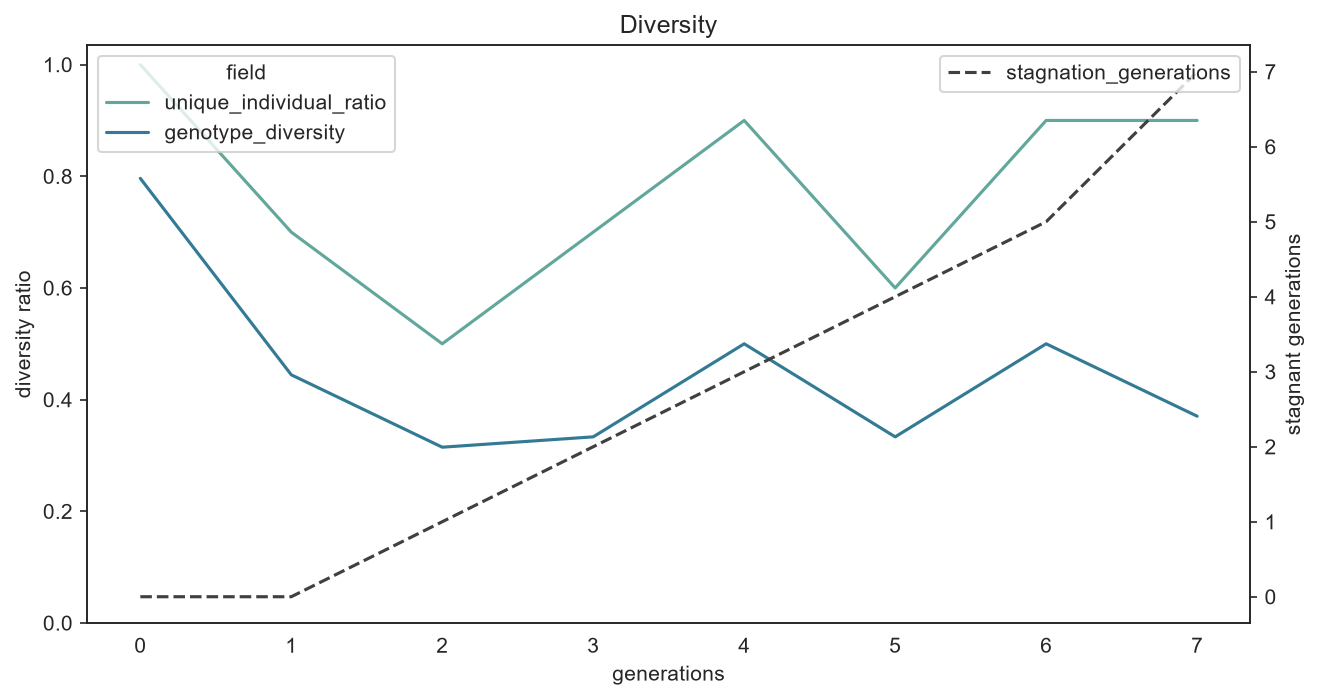
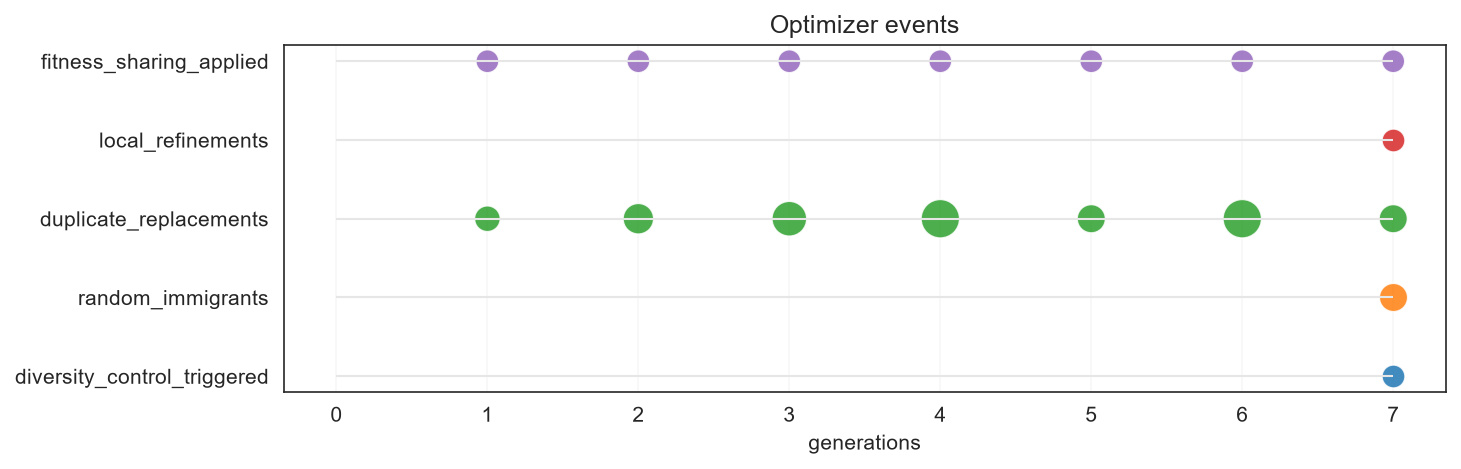
Key telemetry fields:
| Field | Meaning |
|---|---|
finite_fitness_count | Population members with a finite primary score. Compare with population_size. |
unique_individual_ratio | Fraction of distinct individuals. Low → population collapsed |
genotype_diversity | Average probability that two different population members disagree at a coordinate |
stagnation_generations | Generations since fitness_best last improved |
diversity_control_triggered | Whether diversity control fired this generation |
random_immigrants | Number of random candidates injected |
duplicate_replacements | Duplicate offspring replaced before evaluation |
fitness_sharing_applied | Whether niche-aware selection was active |
mean_niche_count / max_niche_count | Crowding during selection |
local_refinements | Neighbor candidates evaluated by local search (usually non-zero only in the final row) |
For feature selection, each coordinate is the decision to include an input column. Diversity includes every member of the current population, including repeated masks. The selector computes this statistic from masks one at a time on wide inputs.
Population mean, standard deviation, minimum and maximum use the finite primary scores. A generation with zero finite scores reports NaN for these summaries. Callbacks that read population statistics use these same values. Candidate rows and cumulative CV calls include failed evaluations. Earlier checkpoint rows may lack finite_fitness_count.
fitness_improvement records the signed gap from the previous best score in the search direction. If the gap exceeds the score dtype's range, the gap is reported as inf or -inf. fitness_best_observed retains the original score.
Fitness sharing applies the crowding penalty during selection. The CV scores in cv_results_ and the reported population statistics retain their original scale, even when sharing rescales extreme scores internally to avoid overflow. On wide feature sets, DEAP packs binary masks and reuses each pairwise distance for both candidates. The number of comparisons still grows quadratically with population size.
Feature Selection Example
The same controls work with GAFeatureSelectionCV. In feature selection, local_search_radius controls the fraction of feature bits flipped when creating local neighbors.
from sklearn.datasets import load_breast_cancer
from sklearn.ensemble import RandomForestClassifier
from sklearn.model_selection import StratifiedKFold, train_test_split

from sklearn_genetic import (
    EvolutionConfig,
    GAFeatureSelectionCV,
    OptimizationConfig,
    PopulationConfig,
    RuntimeConfig,
)
from sklearn_genetic.schedules import ExponentialAdapter

X, y = load_breast_cancer(return_X_y=True)
X_train, X_test, y_train, y_test = train_test_split(
    X, y, test_size=0.25, stratify=y, random_state=42
)

cv = StratifiedKFold(n_splits=4, shuffle=True, random_state=42)

selector = GAFeatureSelectionCV(
    estimator=RandomForestClassifier(random_state=42, n_jobs=1),
    random_state=42,
    cv=cv,
    scoring="roc_auc",
    max_features=18,
    evolution_config=EvolutionConfig(
        population_size=30,
        generations=16,
        crossover_probability=0.8,
        mutation_probability=ExponentialAdapter(
            initial_value=0.1, end_value=0.25, adaptive_rate=0.08
        ),
        keep_top_k=4,
    ),
    population_config=PopulationConfig(initializer="smart"),
    runtime_config=RuntimeConfig(n_jobs=-1, parallel_backend="auto", verbose=True),
    optimization_config=OptimizationConfig(
        diversity_control=True,
        diversity_threshold=0.2,
        diversity_stagnation_generations=4,
        random_immigrants_fraction=0.15,
        fitness_sharing=True,
        sharing_radius=0.2,
        local_search=True,
        local_search_top_k=2,
        local_search_steps=5,
        local_search_radius=0.1,
    ),
)

selector.fit(X_train, y_train)

print("Selected features:", selector.best_features_)
print("Test score:", selector.score(X_test, y_test))
Recommended Workflow
Start simple and add controls based on telemetry:
- Default run — use
PopulationConfig(initializer="smart"),crossover_probability=0.8,mutation_probability=0.1. Inspect history. - If diversity collapses early — enable
OptimizationConfig(diversity_control=True). - If one candidate family dominates — enable
fitness_sharing=True. - If the final region looks close but not fully refined — enable
local_search=True. - If stagnation persists — add adaptive schedules: slowly increase mutation over generations.
Tuning Guidelines
| Parameter | Practical starting range | Notes |
|---|---|---|
diversity_threshold | 0.1–0.3 | Higher triggers earlier |
diversity_mutation_boost | 1.5–2.5 | Too high = next generation is random |
random_immigrants_fraction | 0.05–0.2 | Larger helps rugged spaces; may slow convergence |
sharing_radius | 0.15–0.35 | Smaller = only penalize very similar candidates |
local_search_radius | 0.05–0.15 | Larger = behaves more like an extra mutation phase |
local_search_steps | 1–5 | Each step = extra CV calls |
Practical Notes
- Fitness sharing only changes temporary selection pressure; it does not alter
best_score_,cv_results_, or raw cross-validation scores. - Local search evaluates extra candidates when evolution finishes. A stopping callback can end search before refinement starts.
- Always keep a final holdout set separate from the CV folds for honest model assessment.
Next Steps
- Adaptive Schedules — schedule mutation and crossover rates over generations
- Troubleshooting — diagnose convergence problems using
fit_stats_andhistory - Config Objects API — full parameter reference for
OptimizationConfig
Cheaper search with full-training finalist validation
Both searches can explore using fewer training rows per CV fold, then re-evaluate a small number of distinct finalists on the original folds. subsample_cv changes only the training indices; every validation row stays in place. The evolutionary operators continue to select and generate candidates using these cheaper scores.
subsample_cv names the fold if its training partition is empty. Check the original CV splits when this happens. The helper rounds the retained training count down, so increase train_size if sampling would leave any fold with zero training rows. For stratified sampling, also retain every class present in that fold's original training rows.
Use a separate outer test set to measure whether the speed/quality tradeoff suits your data:
from sklearn.base import clone
from sklearn.datasets import load_breast_cancer
from sklearn.model_selection import StratifiedKFold, train_test_split
from sklearn.pipeline import make_pipeline
from sklearn.preprocessing import StandardScaler
from sklearn.svm import SVC
from sklearn_genetic import GASearchCV, GAFeatureSelectionCV, subsample_cv
from sklearn_genetic.space import Continuous

X, y = load_breast_cancer(return_X_y=True)
X_train, X_test, y_train, y_test = train_test_split(
    X, y, test_size=0.25, stratify=y, random_state=42
)
full_cv = list(StratifiedKFold(3, shuffle=True, random_state=42).split(X_train, y_train))
search_cv = subsample_cv(full_cv, 0.25, stratify=y_train, random_state=42)
model = make_pipeline(StandardScaler(), SVC())
common = dict(
    cv=search_cv,
    scoring="accuracy",
    population_size=8,
    generations=4,
    random_state=42,
    n_jobs=1,
    verbose=False,
    final_selection=True,
    final_selection_top_k=4,
    final_selection_cv=full_cv,
)
hpo = GASearchCV(
    clone(model),
    param_grid={
        "svc__C": Continuous(0.01, 1000, distribution="log-uniform"),
        "svc__gamma": Continuous(0.0001, 1, distribution="log-uniform"),
    },
    **common,
).fit(X_train, y_train)
features = GAFeatureSelectionCV(clone(model), **common).fit(X_train, y_train)
print(hpo.best_score_, hpo.score(X_test, y_test))
print(features.best_score_, features.score(X_test, y_test), features.support_.sum())
For models where each fold is expensive, another option is to replace the subsample_cv(...) line with search_cv = full_cv[:1] and set final_selection_top_k=8 in common. The search then scores candidates on one original fold and validates the eight best distinct candidates on all three folds. This can save more time than shortening each training fold, but preliminary rankings use less validation data and can miss the best candidate. In a six-split five-fold SVC benchmark, this pattern made HPO 4.09–4.81× faster with a mean accuracy loss of 0.00583 on synthetic data. Feature selection was 3.48–3.92× faster but lost mean accuracy on all three datasets. Expanding from eight to 24 finalists did not consistently recover quality. Compare held-out accuracy and the complete fitting time on your own data before choosing either shortcut.
cv_results_, history and the hall of fame retain the original search scores and candidates. final_selection_results_ records each completed evaluation, its fold scores and the validation time. best_score_ describes the final-validation winner and can differ from the corresponding search score in cv_results_. Feature selection breaks equal final scores by preferring fewer columns. If every finalist score is non-finite, fitting raises with the completed evaluations available for inspection.
Use the finalist score plot to compare the two scores for each candidate and identify the row chosen for refit.
Reuse scores from matching folds
For a deterministic estimator, preprocessing pipeline and scorer, use final_selection="reuse_folds" and error_score="raise" when the search and finalist validation share folds. Both training and validation indices must match in order. Subsampling the training rows makes a fold a fresh fit. Leave final_selection_cv=None to use the folds captured during the search. Matching Boolean masks also support reuse. A full-length mask can match its positional indices when they list the same rows in the same order for both training and validation. Negative indices count from the end of the training dataset, so -1 matches the last row. Reuse requires valid row positions. See the Boolean mask example. Score reuse compares plain NumPy arrays, lists, and tuples. Folds with custom selector containers or subclasses are scored afresh using the installed scikit-learn version's indexing rules. Use either integer positions or a full Boolean mask in each selector. When comparing separately supplied folds, a mixed list or tuple on either side requires a fresh finalist fit. Some scikit-learn versions can interpret a mixed sequence differently from an integer array when indexing a DataFrame. An explicit finalist splitter or iterable must yield at least one fold. An empty list or tuple raises before the search starts. Folds supplied as lists, tuples, or NumPy arrays must contain one training selector and one validation selector. NumPy selectors must have an integer or Boolean dtype. A one-dimensional selector in any of these forms must contain valid row positions or a Boolean mask with one entry per row. These checks apply to folds yielded by iterables and splitters as well. The error names the setting, the fold number and, for a bad selector, the partition. Search folds and explicit finalist lists or tuples are checked before candidate evaluation. Other finalist iterables and splitters are checked when their folds are collected for finalist validation. See the split validation example. The matcher can recognize shared index arrays without comparing their contents again. Explicitly supplied folds are checked by their ordered indices. See fit work by phase for an example that reports the reused scores. Each entry of final_selection_results_["candidates"] reports cv_calls, fold_fits, and reused_folds. The first two count work performed for that finalist, including a retry when a partial evaluation cannot be combined with saved scores. reused_folds counts scores from the search that were used in the final result. See the per-finalist example. Reuse can carry over an undefined NaN score. A finalist with an undefined mean score remains ineligible. When every search fold matches one-to-one in the original order, finalist validation reuses the original score array and preserves its numeric dtype. When the search and final validation share the same training or validation selector, the matcher converts that NumPy array, list, or tuple once per comparison. In the original order, each occurrence of a repeated fold keeps its corresponding score. In a reordered sequence, matching occurrences are reused in the order they appeared in the search. If finalist validation requests more copies, the matcher cycles through those scores again. See the repeated-fold example. When finalist CV contains every occurrence from the search in a different order, finalist validation calculates the ordering once and applies it to each candidate's stored score array. This retains the original numeric dtype, including when scores are large. Finalist validation can reuse a subset of large integers when the search stored the scores in an integer array. It combines those exact integers with new integer or floating-point scores and infers the dtype as fresh validation would. Scores stored as Python objects can require a retry. Large scores stored as floats may require fresh validation to recover rounded integers. See the large integer score example. If every finalist fold matches a search fold, a retained finite score with magnitude above 2**64 can establish the floating-point dtype of the subset. For extended precision, the score must also lose precision or range when converted to a Python float. See the large floating-point score example. When the new folds already produce a float64 score array, finalist validation can combine large new scores with saved integer or float64 values whose magnitudes are below 2**53. The combined array stays in double precision. See the example with a new fold. New folds scored in extended precision can also establish the combined array's dtype when the saved scores are small and were stored as integers, doubles, or in the same extended dtype. If only the search array uses extended precision, a retained small value must lose precision when converted to a Python float for the wider dtype to carry over. If it cannot infer the wider dtype, finalist validation can fit the matching folds again. It keeps newly computed float64 scores of magnitude below 2**53 because any integers promoted to those values still fit exactly. Large new scores can require a complete evaluation to recover integers that were rounded on promotion. See the precision recovery example. When matching scores are stored as small integers and the new folds also produce an integer array, validation can combine them even when the new integers are large. A retained fractional double-precision score can also allow reuse when the new folds produce an integer array. The fraction determines that the combined scores use floating-point precision, as in fresh validation. An integer-valued score stored as a float can come from an integer promoted during search. If the finalist folds supply no evidence for a floating-point dtype, validation evaluates the matching folds to recover their original score types. It can keep already computed integer or Boolean scores from new folds when the recovered scores can be combined exactly. Multiple new folds collected as unsigned integers can hide Boolean scores, so validation evaluates the complete list again if the original types are still ambiguous. See the integer score example.
When a custom scorer supplies extended NumPy precision such as numpy.longdouble, search ranks and finalist comparisons use the precision retained by cross-validation. best_score_ and finalist score fields retain that precision on platforms that support it. Ordinary double-precision scores are exposed as Python floats. The mean of a short CV score vector uses a lower-overhead check for ordinary values. When all scores are finite and their sum could overflow, the mean uses a range-preserving reduction.
When resuming from a checkpoint, the five bundled backends can reuse matching fold scores from the saved search. DEAP requires a verified training-data fingerprint and independently captured search folds. Older DEAP checkpoints that lack either piece of information validate finalists afresh. Use final_selection=True when fresh scores are needed for stochastic models or scorers.
Final selection runs with refit=True. Its extra CV evaluations and final refit are additional to the evolutionary budget; generation stopping callbacks do not cap those stages. Include them when timing a workflow. An explicit non-None final_selection_cv overrides the corresponding OptimizationConfig value. Both settings and explicit fold arrays survive cloning and checkpoints.
Each fresh fit captures a custom splitter or iterable's train and validation indices as each fold is produced. A splitter can reuse its index arrays without overwriting earlier folds. If an older checkpoint was created with a splitter that reused arrays, start a fresh fit to apply this behavior to the search.
Use stratify=y_train for classification, and omit it for regression. Sampling that drops a class raises an error; increase the fraction in that case. The discarded rows do not need to contain every class. A fraction of 1 keeps the original training folds. This is opt-in: ordinary searches still use full training folds. Smaller training sets can change candidate rankings, and full validation of finalists cannot recover a good candidate discarded earlier. Measure held-out quality and total time; small datasets or models with high fixed training cost may gain little.
How many finalists fit my compute budget?
With five final folds and one reusable preliminary fold, each distinct finalist costs four additional fits. Five finalists cost 20 fits and eight cost 32, plus the search and final refit. To try a budget of 20 with the deterministic SVC example above, reuse its unfitted configuration and training split:
folds = list(StratifiedKFold(5, shuffle=True, random_state=42).split(X_train, y_train))
budgeted = clone(hpo).set_params(
    cv=folds[:1],
    final_selection="reuse_folds",
    final_selection_cv=folds,
    final_selection_top_k=5,
    error_score="raise",
).fit(X_train, y_train)

counts = budgeted.fit_counts_
print(counts["finalist_fold_fits"], counts["finalist_reused_folds"])
The same counters work for GAFeatureSelectionCV and for searches that produce fewer distinct finalists than requested. They also include additional fits if finalist validation repeats a fold. At a tied preliminary cutoff, the feature selector can include a denser mask. Changing the shortlist size can therefore change which masks qualify.
When several masks tie at that cutoff, the shortlist considers each distinct mask once at that score. A later cache hit for one of those masks leaves the finalists in place. When many rows reuse cached evaluations, feature selection can skip packing a shared Boolean mask again while filling the shortlist or checking denser masks at a tied cutoff. The scan follows the original row order within each score and mask size.
On a large tied cutoff, the selector can restrict mask packing to the largest size group. Distinctness and the order of first occurrences within that group still determine which candidate reaches finalist validation.
In 24 paired comparisons on Breast Cancer (logistic regression) and Diabetes (Ridge), reducing the shortlist from eight to five saved 12 fold fits in every pair. Mean end-to-end time fell by 15–23% across the four dataset/search combinations. Mean held-out ROC AUC for feature selection on Breast Cancer stayed at 0.993501, while mean held-out R² for Diabetes hyperparameter search went from 0.527600 to 0.527351. Each comparison used six outer splits per dataset and a single worker. Download per-split timings, finalist lists and holdout scores (JSON).
Choose a refit candidate with a function
Pass a callable as refit to choose a candidate after the evolutionary search. The function receives cv_results_ and returns an integer row index. Use final_selection=False so the callable makes the final choice. With multiple metrics, set objective_metric to name the scorer used during search and by the refitted estimator's score method.
import numpy as np
from sklearn.datasets import load_iris
from sklearn.tree import DecisionTreeClassifier

from sklearn_genetic import EvolutionConfig, GASearchCV
from sklearn_genetic.space import Integer


def prefer_smaller_tree(results):
    scores = np.asarray(results["mean_test_balanced_accuracy"])
    eligible = np.flatnonzero(np.isfinite(scores) & (scores >= np.nanmax(scores) - 0.01))
    depths = np.asarray(results["param_max_depth"], dtype=int)
    f1 = results["mean_test_f1"]
    return int(min(eligible, key=lambda index: (depths[index], -f1[index])))


X, y = load_iris(return_X_y=True)
search = GASearchCV(
    DecisionTreeClassifier(random_state=42),
    param_grid={"max_depth": Integer(2, 8), "min_samples_leaf": Integer(1, 5)},
    scoring={"balanced_accuracy": "balanced_accuracy", "f1": "f1_macro"},
    objective_metric="balanced_accuracy",
    refit=prefer_smaller_tree,
    evolution_config=EvolutionConfig(population_size=8, generations=2),
    random_state=42,
    error_score="raise",
    verbose=False,
).fit(X, y)
ranked = search.cv_results_dataframe(preserve_index=True)
chosen = ranked.loc[search.best_index_]
chosen_cv_score = chosen["mean_test_balanced_accuracy"]
Both search estimators expose the chosen row as best_index_ and fit that candidate on all training data. The preserved index lets you use .loc[search.best_index_] directly in the rank-sorted table.
Refit the best observed feature mask
With use_cache=False, a stochastic model or scorer can give a repeated feature mask different scores. Standard refit without finalist validation follows the elite archive, which can keep an earlier observation. When several rows match a finite archived score for the same mask, the first matching row supplies best_index_. Use a callable to choose the highest-ranked finite observation directly from cv_results_. This example prefers smaller masks at equal ranks. The rank column already reflects the configured search direction.
import numpy as np
from sklearn.datasets import load_breast_cancer
from sklearn.ensemble import RandomForestClassifier
from sklearn.model_selection import train_test_split

from sklearn_genetic import GAFeatureSelectionCV


def best_observed_mask(results):
    usable = np.isfinite(results["mean_test_score"]) & ~results["all_fits_failed"]
    eligible = np.flatnonzero(usable)
    if eligible.size == 0:
        raise ValueError("No feature mask has a finite search CV score.")
    ranks = np.asarray(results["rank_test_score"])[eligible]
    sizes = np.asarray(results["n_features"])[eligible]
    return int(eligible[np.lexsort((sizes, ranks))[0]])


X, y = load_breast_cancer(return_X_y=True)
X_train, X_test, y_train, y_test = train_test_split(
    X, y, stratify=y, test_size=0.25, random_state=42
)
selector = GAFeatureSelectionCV(
    RandomForestClassifier(n_estimators=16, n_jobs=1),
    cv=3,
    scoring="balanced_accuracy",
    use_cache=False,
    refit=best_observed_mask,
    population_size=6,
    generations=2,
    random_state=42,
    n_jobs=1,
    verbose=False,
).fit(X_train, y_train)

print(selector.cv_results_["mean_test_score"][selector.best_index_])
print(selector.score(X_test, y_test))
Callable refit reads the recorded scores and runs one full-training fit. Use the selected row for its CV score. A high score from one repeat can reflect training randomness. For a decision based on fresh finalist scores, use final_selection=True with standard refit.
Break an exact CV tie by fold dispersion
With a single scoring metric, pass refit=prefer_lower_dispersion if you want the candidate with the lowest fold-score standard deviation among the top-ranked rows. For feature selection, the function first restricts those rows to the smallest feature sets.
import numpy as np


def prefer_lower_dispersion(cv_results):
    ranks = np.asarray(cv_results["rank_test_score"])
    tied = np.flatnonzero(ranks == ranks.min())
    if "n_features" in cv_results:
        counts = np.asarray(cv_results["n_features"])[tied]
        tied = tied[counts == counts.min()]
    std = np.asarray(cv_results["std_test_score"])[tied]
    return int(tied[np.where(np.isfinite(std), std, np.inf).argmin()])
This rule uses the existing fold scores. Evaluate the refitted estimator on held-out data to assess how it performs beyond those folds.
Inspect the selected candidate without refitting
Use refit=False to compare candidates using search CV alone. Both search estimators skip finalist validation and the full-data fit. In a multi-metric search, use objective_metric to choose the score that guides the optimizer.
from sklearn.datasets import load_iris
from sklearn.tree import DecisionTreeClassifier

from sklearn_genetic import EvolutionConfig, GASearchCV
from sklearn_genetic.space import Integer

X, y = load_iris(return_X_y=True)
search = GASearchCV(
    DecisionTreeClassifier(random_state=42),
    param_grid={"max_depth": Integer(2, 8), "min_samples_leaf": Integer(1, 5)},
    scoring={"accuracy": "accuracy", "f1": "f1_macro"},
    objective_metric="f1",
    refit=False,
    evolution_config=EvolutionConfig(population_size=8, generations=2),
    random_state=42,
    verbose=False,
).fit(X, y)

selected = search.cv_results_dataframe(preserve_index=True).loc[search.best_index_]
print(search.best_params_, search.best_score_, selected["mean_test_f1"])
print(search.fit_counts_["refit_fits"])  # 0
print(len(search), search[-1]["cross_validate_calls"])
With GAFeatureSelectionCV, use support_ to inspect the selected mask and best_index_ to find its row in cv_results_. Both estimators report the selected candidate's CV objective score as best_score_.
Use len(search) for the number of recorded generations, search[-1] for the last report, or list(search) for all reports. After early stopping, only recorded reports count. To compare progress by evaluation cost, use the candidate CV calls axis.