
Tuning Outlier Detection Models: IsolationForest and LocalOutlierFactor
GASearchCV and GAFeatureSelectionCV can evaluate scikit-learn outlier detectors on validation folds. Use a custom scorer to compare anomaly scores with known labels. For unlabeled samples, use the default scorer or define an objective for your application.
Prerequisites
- Completed Basic Usage
- Ground-truth labels for the ROC AUC examples
Score unlabeled samples
Call search.fit(X_train) or selector.fit(X_train) for an unlabeled training set. Pass labels as y when your validation scorer uses ground truth. For a new unlabeled search, the detector and scorer receive no target. A custom scorer can have the signature (estimator, X) or accept an optional third argument y=None. See the executable example with both search classes.
With scoring=None, the search scores each validation fold using the detector fitted on that fold's training rows. The default score is the mean of score_samples(X) or, when that method is unavailable, the mean of decision_function(X). A detector that exposes only predict is scored by the fraction of predictions equal to 1 (inliers).
Each candidate must expose at least one of these methods for unseen data. For LocalOutlierFactor, set novelty=True. If a checkpoint contains scores from the old fit_predict fallback, use a new checkpoint file for the search.
The Custom Scorer Pattern
The general pattern for any outlier estimator is to pass a callable scorer with the sklearn estimator signature:
from sklearn.metrics import roc_auc_score

def outlier_roc_auc(estimator, X, y):
    # Replace .score_samples with the method appropriate for your estimator
    # (see table below)
    scores = -estimator.score_samples(X)
    return roc_auc_score(y, scores)

scoring = outlier_roc_auc
Two details matter:
- Negate the score —
score_samplesanddecision_functionreturn lower values for anomalies, butroc_auc_scoreexpects higher values for the positive class (y=1= outlier). Negating aligns them. Omitting the negation causes the GA to silently optimise in the wrong direction. - Use the estimator-aware scorer signature — the callable receives
(estimator, X, y), so it can callscore_samplesdirectly. Do not wrap this pattern withmake_scorer, which is intended for functions that receivey_trueand predictions.
Which scoring method to use
| Estimator | Method | Notes |
|---|---|---|
IsolationForest | score_samples | Always available; independent of contamination |
LocalOutlierFactor(novelty=True) | score_samples | Requires novelty=True at construction |
LocalOutlierFactor(novelty=False) | negative_outlier_factor_ | Attribute set after fit; only usable on training data |
OneClassSVM | score_samples | Available since sklearn 0.24 |
EllipticEnvelope | score_samples | Also has decision_function |
LocalOutlierFactor default mode cannot score new data
Standard LOF (novelty=False) computes scores on its training rows. Use LocalOutlierFactor(novelty=True) to score each fold's unseen validation rows.
Choose validation folds
GASearchCV and GAFeatureSelectionCV both accept a scikit-learn splitter or an iterable of train and validation indices in cv. With labeled anomalies, pass StratifiedKFold and supply the labels to fit so each validation fold has anomalies to score. If multiple rows come from the same device, patient, or other unit, use GroupKFold and pass its group labels as groups to fit to keep each group on one side of every split. With an integer or None, the search uses KFold.
Checkpoint resumes keep the folds used to score saved candidates. Compatible older outlier checkpoints also retain the synthetic zero targets they used for unlabeled scoring. Use a new checkpoint path for target-free scoring or to change the splitter.
After refit, call GAFeatureSelectionCV.score(X_test, y_test) to apply the configured scorer to held-out samples using the selected features. With the default anomaly scorer, pass just X_test to score unlabeled samples.
IsolationForest Example
import numpy as np
from sklearn.datasets import make_blobs
from sklearn.ensemble import IsolationForest
from sklearn.metrics import roc_auc_score
from sklearn.model_selection import StratifiedKFold, train_test_split

from sklearn_genetic import EvolutionConfig, GASearchCV, PopulationConfig, RuntimeConfig
from sklearn_genetic.plots import plot_cv_scores, plot_score_landscape
from sklearn_genetic.space import Continuous, Integer

# Synthetic dataset: two normal clusters + 5% uniform outliers
X_normal, _ = make_blobs(n_samples=475, centers=2, cluster_std=0.8, random_state=42)
rng = np.random.default_rng(42)
X_outliers = rng.uniform(low=-6, high=6, size=(25, 2))

X = np.vstack([X_normal, X_outliers])
y = np.array([0] * 475 + [1] * 25)   # 0 = normal, 1 = outlier

X_train, X_test, y_train, y_test = train_test_split(
    X, y, test_size=0.2, stratify=y, random_state=42
)
cv = StratifiedKFold(n_splits=3, shuffle=True, random_state=42)


def outlier_roc_auc(estimator, X, y):
    scores = -estimator.score_samples(X)
    return roc_auc_score(y, scores)


search = GASearchCV(
    estimator=IsolationForest(random_state=42),
    random_state=42,
    param_grid={
        "n_estimators":  Integer(50, 300),
        "max_samples":   Continuous(0.05, 0.80),
        "contamination": Continuous(0.01, 0.20),
        "max_features":  Continuous(0.5, 1.0),
    },
    cv=cv,
    scoring=outlier_roc_auc,
    evolution_config=EvolutionConfig(population_size=15, generations=12),
    population_config=PopulationConfig(initializer="smart"),
    runtime_config=RuntimeConfig(n_jobs=-1, verbose=True),
)

search.fit(X_train, y_train)

print("Best CV ROC AUC:", round(search.best_score_, 4))
print("Best parameters:", search.best_params_)
Anomaly searches can look stable even when the scorer is sensitive to the thresholding parameters. The landscape view shows how the best regions depend on max_samples and contamination:
import matplotlib.pyplot as plt

plot_score_landscape(search, x="max_samples", y="contamination")
plt.show()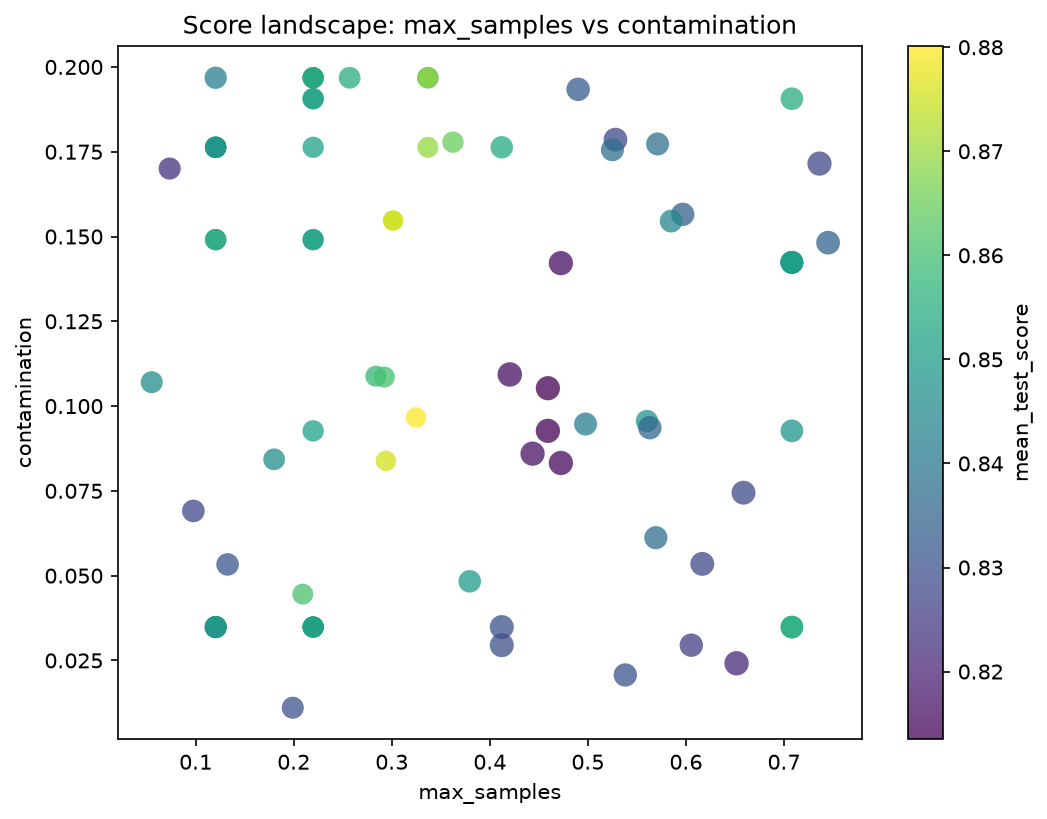
Use the fold-level plot to check whether top candidates are consistently strong or just lucky on one split:
plot_cv_scores(search, top_k=5, label_params=["max_samples", "contamination"])
plt.show()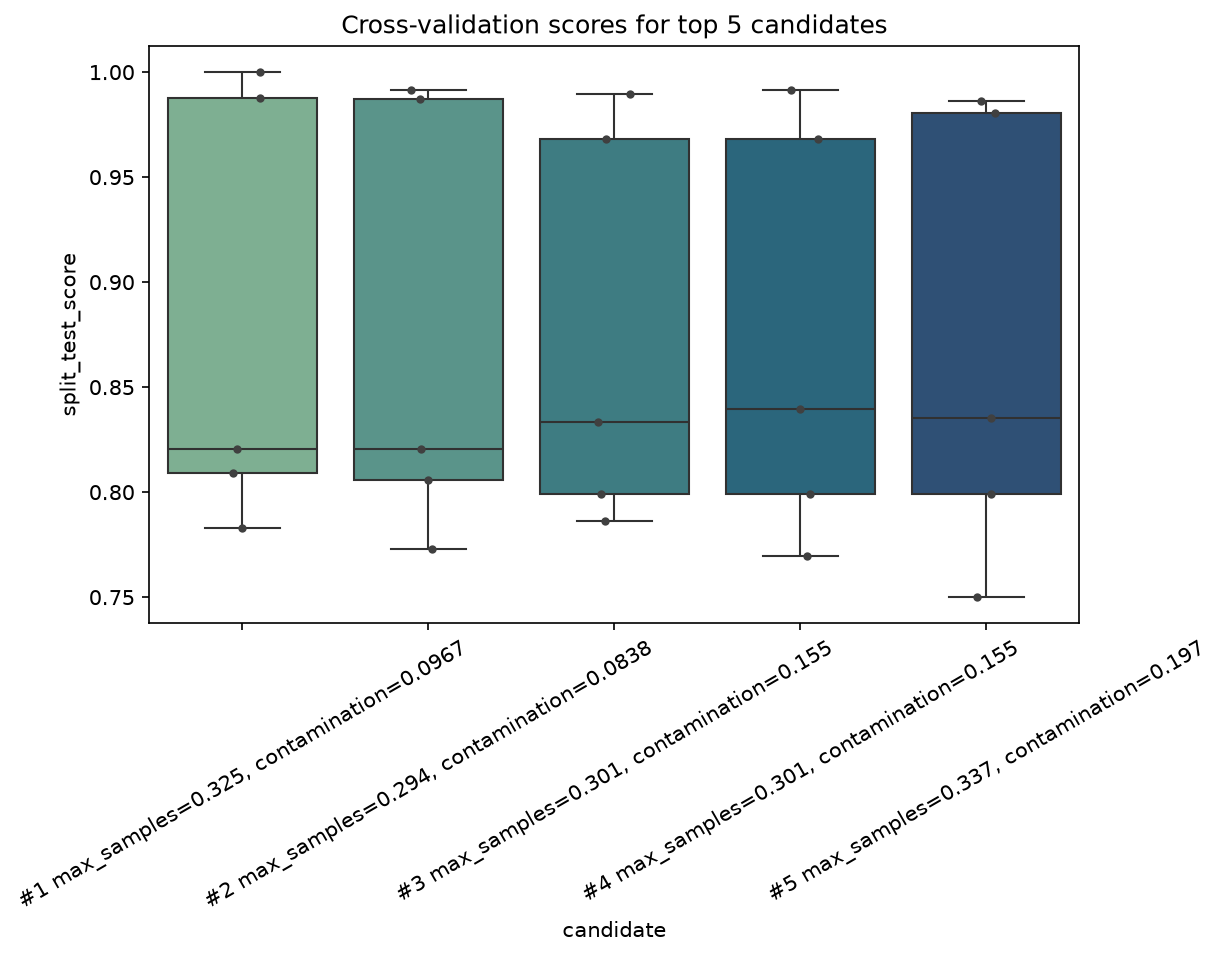
LocalOutlierFactor Example
LOF requires novelty=True for use inside cross-validation. The scorer is identical.
from sklearn.neighbors import LocalOutlierFactor

lof_search = GASearchCV(
    estimator=LocalOutlierFactor(novelty=True),
    random_state=42,
    param_grid={
        "n_neighbors":       Integer(5, 50),
        "contamination":     Continuous(0.01, 0.20),
        "leaf_size":         Integer(10, 60),
    },
    cv=cv,
    scoring=outlier_roc_auc,
    evolution_config=EvolutionConfig(population_size=15, generations=10),
    population_config=PopulationConfig(initializer="smart"),
    runtime_config=RuntimeConfig(n_jobs=-1, verbose=True),
)

lof_search.fit(X_train, y_train)

print("Best CV ROC AUC:", round(lof_search.best_score_, 4))
print("Best parameters:", lof_search.best_params_)
Tips & Gotchas
- Always negate the score —
score_samplesis lower for anomalies. Pass-score_samplestoroc_auc_scorewheny=1is the outlier class. Getting this wrong produces a valid-looking search that quietly minimises detection quality. - Pass a callable scorer directly — outlier estimators have no
predict_proba, and the scorer needs access to the estimator so it can callscore_samples. - Use
StratifiedKFold— with 5% outliers, plainKFoldcan produce folds with very few anomalies, making the AUC estimate noisy and the fitness signal unreliable. contaminationaffectspredict, notscore_samples— tuning it improves the hard-decision boundary but not the ranking score. If your downstream use only needs ranking (e.g., a top-K alert list), fixcontaminationbased on domain knowledge and remove it from the search space.score_samplesis independent ofcontaminationfor IsolationForest — you can optimise the scorer freely without worrying that contamination is circularly influencing the metric used to select it.- LOF with
novelty=Falsecannot score new data — attemptingscore_sampleson test data raises an error. Always setnovelty=Truewhen using LOF insideGASearchCV.
Next Steps
- Isolation Forest Tutorial — full end-to-end walkthrough with contour plots, ROC curve, and a 3-way comparison against baseline and random search.
- Callbacks — add early stopping to avoid over-tuning on a noisy anomaly scorer.
- Troubleshooting — diagnose flat fitness when the search space is too narrow.