
Development version
This is the latest (dev) documentation. It may contain unreleased features or breaking changes. For the stable release, use stable.
Switch optimization backends in a scikit-learn search
Use the same folds and scorer when changing engines. This walkthrough uses all five named backends and keeps a test partition for the final model.
Install the engines
Follow the installation guide for your version. To run every example, select the scipy, nevergrad, cmaes and pymoo extras. For a single engine, select just its extra. The fitness chart also uses the plot extra. The examples use built-in scikit-learn data. The parallel examples request two candidate workers.
from sklearn.base import clone
from sklearn.datasets import load_breast_cancer
from sklearn.metrics import balanced_accuracy_score
from sklearn.model_selection import StratifiedKFold, train_test_split
from sklearn.tree import DecisionTreeClassifier
from sklearn_genetic import GAFeatureSelectionCV, GASearchCV
from sklearn_genetic.space import Categorical, Continuous, Integer

X, y = load_breast_cancer(return_X_y=True)
X_train, X_test, y_train, y_test = train_test_split(
    X, y, stratify=y, test_size=0.25, random_state=7
)
model = DecisionTreeClassifier(random_state=7)
folds = StratifiedKFold(3, shuffle=True, random_state=7)
settings = dict(cv=folds, scoring="balanced_accuracy", refit=True, random_state=7,
                population_size=8, generations=2, n_jobs=1, verbose=False)
search = GASearchCV(
    model,
    param_grid={"max_depth": Integer(2, 10), "criterion": Categorical(["gini", "entropy"]),
                "ccp_alpha": Continuous(1e-6, 0.1, distribution="log-uniform")},
    **settings,
)
Change the engine
Clone the template to start a fresh search. Inspect the best CV score and the number of real CV calls. A cache hit reuses a score, and DEAP's default algorithm can generate more offspring per generation. Each real CV call here fits three folds. The engines share candidate preparation. Scalar search parameters such as the tree depth and criterion can be passed directly into a cloned estimator. Mutable choices such as dictionaries or pipeline steps are cloned using scikit-learn's rules before they are applied.
fitted = {}
for engine in ("deap", "scipy", "nevergrad", "cmaes", "pymoo"):
    run = clone(search).set_params(optimizer_backend=engine).fit(X_train, y_train)
    fitted[engine] = run
print(engine, round(run.best_score_, 3), run.fit_stats_["cross_validate_calls"])deap 0.941 39
scipy 0.941 23
nevergrad 0.941 23
cmaes 0.941 24
pymoo 0.928 20Inspect one fitted model on the held-out data. The choice of SciPy here is fixed in advance. Use cv_results_ for individual candidates and history for generations. SciPy proposes values for the log-uniform pruning parameter in logarithmic coordinates. The candidate table shows each value in the tree's original units. For a performance comparison across datasets and seeds, see the matched-budget benchmark.
run = fitted["scipy"]
print("candidate rows", len(run.cv_results_["mean_test_score"]))
pruning = run.cv_results_["param_ccp_alpha"]
print("pruning range", round(min(pruning), 7), round(max(pruning), 7))
print("CV calls by generation", list(run.history["cross_validate_calls"]))
print("test balanced accuracy", round(balanced_accuracy_score(y_test, run.predict(X_test)), 3))candidate rows 24
pruning range 1.4e-06 0.0522366
CV calls by generation [8, 16, 23]
test balanced accuracy 0.917Keep an integer parameter fixed
Set both integer bounds to the same value to keep a parameter fixed in the search space. Here smart initialization varies the tree depth and keeps two training samples per leaf as the minimum. The fixed value appears in every candidate record. The pruning parameter uses log-uniform sampling inside its positive bounds.
from sklearn_genetic.callbacks import CVBudgetStopping

fixed = clone(search).set_params(
    param_grid={
        "max_depth": Integer(2, 8),
        "min_samples_leaf": Integer(2, 2),
        "ccp_alpha": Continuous(1e-6, 1e-2, distribution="log-uniform"),
    },
    use_cache=False,
)
fixed.fit(X_train, y_train, callbacks=CVBudgetStopping(4))
print("Sampled depths", fixed.cv_results_["param_max_depth"])
print("Fixed leaf minimums", fixed.cv_results_["param_min_samples_leaf"])
print("Sampled pruning strengths", [round(value, 6) for value in fixed.cv_results_["param_ccp_alpha"]])INFO: Stopping the algorithm
Sampled depths [7, 5, 5, 4]
Fixed leaf minimums [2, 2, 2, 2]
Sampled pruning strengths [0.009061, 4.1e-05, 0.003083, 1.8e-05]For a grid made entirely of built-in integer dimensions, the standard evaluator can reuse the repaired values when dispatching each candidate. Here the leaf minimum stays fixed and the depth varies.
integer_only = clone(fixed).set_params(
    param_grid={"max_depth": Integer(2, 8), "min_samples_leaf": Integer(2, 2)},
).fit(X_train, y_train, callbacks=CVBudgetStopping(4))
print("Candidate integers", integer_only.cv_results_["params"])
print("Search CV calls", integer_only.fit_counts_["search_cv_calls"])INFO: Stopping the algorithm
Candidate integers [{'max_depth': 8, 'min_samples_leaf': 2}, {'max_depth': 3, 'min_samples_leaf': 2}, {'max_depth': 5, 'min_samples_leaf': 2}, {'max_depth': 7, 'min_samples_leaf': 2}]
Search CV calls 4Select features and inspect progress
Pass the same keyword to GAFeatureSelectionCV. pymoo evolves binary masks and repairs proposals as needed to keep at least one column and respect max_features. The estimator applies the selected mask for prediction. A stopping callback checks each reported generation. Here the callback stops after generation 1 so we can resume the original two-generation budget and measure additional CV calls. To inspect CV scores and subset sizes without converting the masks to lists, request those columns and keep the original candidate positions as labels. Pass top_k when you only need the first few ranked candidates.
from pathlib import Path
from tempfile import TemporaryDirectory
from sklearn_genetic.callbacks import BaseCallback, ModelCheckpoint

class StopAfterOne(BaseCallback):
    def on_step(self, record=None, logbook=None, estimator=None):
        return record["gen"] == 1

selector = GAFeatureSelectionCV(model, optimizer_backend="pymoo", max_features=8, **settings)
with TemporaryDirectory() as directory:
    checkpoint = ModelCheckpoint(Path(directory) / "progress.pkl")
    clone(selector).fit(X_train, y_train, callbacks=[StopAfterOne(), checkpoint])
    saved = checkpoint.load()
    selector.fit(X_train, y_train, callbacks=[checkpoint])

print("checkpoint", saved["backend"], saved["logbook"][-1]["gen"], saved["resumable"])
print("final generation", selector.history["gen"][-1])
print("additional CV calls",
      selector.fit_stats_["cross_validate_calls"] - saved["fit_stats"]["cross_validate_calls"])
mask_sizes = selector.cv_results_["n_features"]
print("evaluated subset sizes", min(mask_sizes), "to", max(mask_sizes))
print("selected columns", selector.get_support(indices=True).tolist())
print("test balanced accuracy", round(balanced_accuracy_score(y_test, selector.predict(X_test)), 3))
ranked = selector.cv_results_dataframe(
    columns=["n_features", "mean_test_score"], preserve_index=True, top_k=3
)
print(ranked.round(3).reset_index().to_string(index=False))checkpoint pymoo 1 True
final generation 2
additional CV calls 6
evaluated subset sizes 1 to 8
selected columns [6, 11, 12, 15, 23, 27]
test balanced accuracy 0.901
candidate_index n_features mean_test_score
11 6 0.934
17 6 0.934
18 6 0.934SciPy and pymoo verify the recorded proposals while reconstructing the solver, using saved results for generations already completed. Nevergrad and CatCMAwM restore native solver state. Use the same data, search settings and environment when resuming. Work in a partially completed generation can require CV again. The checkpoint recipe also covers DEAP's historical format and older progress-only files. Third-party engines can implement continuation through the optimizer protocol.
Diagnose an invalid checkpoint counter
A resumable optimizer snapshot includes the cumulative counters in fit_stats, including cache hits and worker batches. fit checks those counters before evaluating candidates. This example writes a separate temporary copy with an invalid cache-hit count to show the error.
import pickle

with TemporaryDirectory() as directory:
    invalid_path = Path(directory) / "invalid-counter.pkl"
    invalid = {**saved, "fit_stats": {**saved["fit_stats"], "cache_hits": -1}}
    invalid_path.write_bytes(pickle.dumps(invalid))

    try:
        clone(selector).fit(X_train, y_train, callbacks=ModelCheckpoint(invalid_path))
    except ValueError as error:
        print(str(error).replace(str(invalid_path), invalid_path.name))
    else:
raise AssertionError("Expected invalid checkpoint counter to fail")Invalid search checkpoint at invalid-counter.pkl: fit_stats.cache_hits must be a nonnegative integer. Use a new checkpoint path to start a search.Compare feature selection at the same CV budget
Use CVBudgetStopping to cap fresh candidate evaluations even when a generation has more proposals than your budget. This example disables caching so each evaluated mask uses one of the four available CV calls. Each call fits three folds, and the final refit has its own count.
from sklearn_genetic.callbacks import CVBudgetStopping

for engine in ("scipy", "pymoo"):
    limited = clone(selector).set_params(optimizer_backend=engine, use_cache=False)
    limited.fit(X_train, y_train, callbacks=CVBudgetStopping(4))
    costs = limited.fit_counts_
    masks = limited.cv_results_["features"]
    print(engine, "CV calls", costs["search_cv_calls"],
          "fold fits", costs["search_fold_fits"], "refits", costs["refit_fits"],
          "recorded masks", len(masks),
"within feature limit", all(1 <= mask.sum() <= limited.max_features for mask in masks))scipy CV calls 4 fold fits 12 refits 1 recorded masks 4 within feature limit True
pymoo CV calls 4 fold fits 12 refits 1 recorded masks 4 within feature limit TrueThe budget limits fresh search CV. The selector still constructs its initial population, and optional finalist validation and refit have their own costs. Built-in initialization prepares feature masks within the requested bounds and reuses those masks during setup. DEAP also uses the prepared masks for its first evaluation batch with no callbacks or when the built-in CV budget callback is the only callback. SciPy and pymoo propose binary feature masks. The selector validates their width and selected column count and can evaluate integer masks directly after that check. The recorded masks in cv_results_ are Boolean arrays. The batch evaluator prepares private masks as candidates are dispatched. With caching enabled and at least 4,096 sparse input columns, the native evaluator can build that writable mask from the already prepared tuple key. Serial evaluation prepares one row at a time, and the standard population worker pool keeps a bounded number of rows in flight. For fresh feature selection runs, pymoo, Nevergrad and CatCMAwM can reuse the immutable initial masks until dispatch. With a CV budget, cache key checks stop at or before the first proposal that would exceed the remaining call budget, including with an active timer. With a timer, the evaluator checks cache keys in dispatch-sized batches within the remaining CV budget, including a lookahead to the next fresh candidate. Reusable scores in the completed prefix appear in order. Cache lookups require caching to be enabled. The recorded masks reflect the proposals completed. When comparing runtime, keep the data, folds, seeds and worker settings fixed. Compare the observed CV counts and record held-out scores separately. cv_results_["mean_fit_time"] and cv_results_["mean_score_time"] summarize recorded fold timings in seconds. Time the full fit call to include optimizer work, candidate dispatch, summary preparation, and refit. To visualize fresh fits and reused scores, see the fit-work example.
Compare initial mask order at a fixed CV budget
The "spread" initializer visits a wider range of mask sizes early in the same population drawn by "smart". Compare both orders when your CV budget is smaller than population_size. The example also fits both orders with enough CV calls for the full initial population.
for budget in (4, 8):
    for initializer in ("smart", "spread"):
        ordered = clone(selector).set_params(
            population_initializer=initializer, population_size=8, generations=1,
            use_cache=True,
        )
        ordered.fit(X_train, y_train, callbacks=CVBudgetStopping(budget))
        holdout = balanced_accuracy_score(y_test, ordered.predict(X_test))
        print(initializer, "CV calls", ordered.fit_counts_["search_cv_calls"],
              "sizes", [int(size) for size in ordered.cv_results_["n_features"]],
              "selected", int(ordered.get_support().sum()),
"CV", round(ordered.best_score_, 3), "holdout", round(holdout, 3))smart CV calls 4 sizes [1, 2, 3, 4] selected 4 CV 0.915 holdout 0.951
spread CV calls 4 sizes [4, 8, 1, 6] selected 6 CV 0.93 holdout 0.899
smart CV calls 8 sizes [1, 2, 3, 4, 5, 6, 7, 8] selected 6 CV 0.93 holdout 0.899
spread CV calls 8 sizes [4, 8, 1, 6, 2, 3, 5, 7] selected 6 CV 0.93 holdout 0.899Use the actual call counts to compare the two orders. Check the CV and holdout scores separately and inspect the selected subset size. Larger masks can raise fit cost even at equal CV counts. Run the comparison across several seeds and splits before choosing an order for your workload.
Choose a CV budget at startup
A CVBudgetStopping subclass can set a positive integer limit in on_start after inspecting the materialized search folds. Call the base method so the callback counts fresh work in each fit, including resumes. With several budget callbacks, the smallest initialized limit applies.
class FoldAwareBudget(CVBudgetStopping):
    def on_start(self, estimator=None):
        super().on_start(estimator)
        self.max_cv_calls = 4 if estimator.n_splits_ >= 5 else 8

adaptive = clone(search).set_params(cv=5, use_cache=False).fit(
    X_train, y_train, callbacks=[CVBudgetStopping(6), FoldAwareBudget(12)],
)
print("Search CV calls", adaptive.fit_counts_["search_cv_calls"])
print("Search fold fits", adaptive.fit_counts_["search_fold_fits"])INFO: Stopping the algorithm
Search CV calls 4
Search fold fits 20Inspect actual work for each finalist
Use the same three search folds and compare fresh, partial, and full reuse for a deterministic estimator. cv_calls counts actual calls for a finalist, and fold_fits counts each new estimator fit in those calls. reused_folds counts the search scores that contributed to the final score. If a partial evaluation requires a retry, fold_fits includes both attempts. With mixed numeric scores, reuse depends on whether combining the values preserves the precision of fresh validation. See score reuse and precision. Finalist comparisons and reported scores retain an extended NumPy dtype when the scorer and platform provide it. For feature selection, cached repeats of a mask count as one shortlist candidate. At a large tied cutoff, the selector can restrict packing to the largest eligible masks and keep their first-occurrence order. See how tied and cached masks count toward the shortlist.
search_folds = list(folds.split(X_train, y_train))
extra_folds = list(StratifiedKFold(3, shuffle=True, random_state=23).split(X_train, y_train))
for label, mode, final_cv in (
    ("Fresh", True, None),
    ("Partial reuse", "reuse_folds", [search_folds[0], search_folds[1], extra_folds[2]]),
    ("Full reuse", "reuse_folds", None),
):
    finalist_run = clone(search).set_params(
        cv=search_folds, final_selection=mode, final_selection_cv=final_cv,
        final_selection_top_k=2, use_cache=False, error_score="raise",
        population_size=4, generations=0,
    ).fit(X_train, y_train)
    print(label, [(row["cv_calls"], row["fold_fits"], row["reused_folds"])
for row in finalist_run.final_selection_results_["candidates"]])Fresh [(1, 3, 0), (1, 3, 0)]
Partial reuse [(1, 1, 2), (1, 1, 2)]
Full reuse [(0, 0, 3), (0, 0, 3)]Each tuple gives CV calls, new fold fits, and reused scores for one finalist. Read fit_counts_ for totals across finalists and the rest of the fit. For hyperparameter search, tied search ranks promote distinct configurations in evaluation order. Read each finalist's index to locate its row in cv_results_. In feature selection, scikit-learn clones the estimator for each new fold fit during search and finalist validation. The final refit uses its own clone of the estimator on the selected columns.
Read the elapsed seconds for each phase of the last fit in the loop. Compare these durations alongside fit_counts_ when diagnosing fit cost. See fit time by phase for the work measured by each field.
phase_seconds = {
    "search": finalist_run.search_time_,
    "finalist_validation": finalist_run.final_selection_results_["time_seconds"],
    "refit": finalist_run.refit_time_,
}
Preserve repeated folds in the same order
When the search and finalist fold sequences match in order, each finalist score comes from the corresponding search position. This includes repeated train/test pairs. The controlled scorer below gives different values to two occurrences of the same split so you can see which scores were reused.
repeated_folds = [search_folds[0], search_folds[1], search_folds[0]]
repeated_scores = iter((0.25, 0.5, 1.0))

def controlled_score(estimator, X, y):
    return next(repeated_scores) if estimator.max_depth == 2 else 0.5

repeat_run = GASearchCV(
    DecisionTreeClassifier(random_state=42),
    param_grid={"max_depth": Integer(2, 3), "criterion": Categorical(["gini"])},
    cv=repeated_folds, scoring=controlled_score, final_selection="reuse_folds",
    final_selection_top_k=2, population_size=6, generations=0,
    random_state=42, error_score="raise", verbose=False,
).fit(X_train, y_train)
best = repeat_run.final_selection_results_["candidates"][0]
print("Winner depth", repeat_run.best_params_["max_depth"])
print("Fold scores in search order", best["cv_scores"])
print("New finalist fold fits", repeat_run.fit_counts_["finalist_fold_fits"])Winner depth 2
Fold scores in search order [0.25, 0.5, 1.0]
New finalist fold fits 0Reordering a complete set of folds also preserves each saved occurrence. All finalists share one ordering of the saved scores and keep their numeric dtype. Here a deterministic scorer scales accuracy by 1e20 to demonstrate that case.
def scaled_accuracy(estimator, X, y):
    return estimator.score(X, y) * 1e20

reordered = clone(search).set_params(
    cv=repeated_folds,
    final_selection_cv=[repeated_folds[1], repeated_folds[0], repeated_folds[2]],
    scoring=scaled_accuracy, final_selection="reuse_folds",
    final_selection_top_k=2, error_score="raise",
).fit(X_train, y_train, callbacks=CVBudgetStopping(4))
counts = reordered.fit_counts_
print("Reused scores", counts["finalist_reused_folds"])
print("New finalist fold fits", counts["finalist_fold_fits"])INFO: Stopping the algorithm
Reused scores 6
New finalist fold fits 0Reuse large integer scores with new folds
A custom scorer can return integer totals that exceed the exact range of double-precision floats. This example adds a large offset to the number of correct predictions on two search folds and returns a fractional score on a third, new fold. The search stores the original integers. Finalist validation combines them with the new score using the numeric dtype of a fresh run.
import numpy as np

positions = np.arange(len(y_train))
integer_folds = [(positions[:-size], positions[-size:]) for size in (12, 14)]
extra_fold = (positions[:-16], positions[-16:])

def integer_total(estimator, X, y):
    correct = int(np.count_nonzero(estimator.predict(X) == y))
    if len(y) == 16:
        return correct + 0.25
    return 2**54 + 2 * correct + 1

integer_template = clone(search).set_params(
    cv=integer_folds, final_selection_cv=[*integer_folds, extra_fold],
    scoring=integer_total, final_selection_top_k=1, population_size=4,
    generations=0, use_cache=False, error_score="raise",
)
full_validation = clone(integer_template).set_params(final_selection=True).fit(X_train, y_train)
reused_validation = clone(integer_template).set_params(final_selection="reuse_folds").fit(
    X_train, y_train
)
full_row = full_validation.final_selection_results_["candidates"][0]
reused_row = reused_validation.final_selection_results_["candidates"][0]
assert full_row["cv_scores"] == reused_row["cv_scores"]
print("Full validation fold fits", full_row["fold_fits"])
print("New fold fits with reuse", reused_row["fold_fits"])
print("Reused scores", reused_row["reused_folds"])Full validation fold fits 3
New fold fits with reuse 1
Reused scores 2Reuse very large floating-point scores from a subset
Here the scorer uses a floating-point scale above the range of a NumPy integer. Every finalist fold matches a search fold. A retained finite score with magnitude above 2**64 establishes that the subset needs floating-point precision. For extended NumPy precision, the subset must also retain a score outside the precision or range of a Python float.
def scaled_accuracy(estimator, X, y):
    return (1.0 + float(np.mean(estimator.predict(X) == y))) * 2.0**90

float_template = clone(integer_template).set_params(
    cv=[*integer_folds, extra_fold],
    final_selection_cv=integer_folds[::-1],
    scoring=scaled_accuracy,
)
fresh_float = clone(float_template).set_params(final_selection=True).fit(X_train, y_train)
reused_float = clone(float_template).set_params(final_selection="reuse_folds").fit(
    X_train, y_train
)
fresh_row = fresh_float.final_selection_results_["candidates"][0]
reused_row = reused_float.final_selection_results_["candidates"][0]
assert fresh_row["cv_scores"] == reused_row["cv_scores"]
assert fresh_float.best_score_ == reused_float.best_score_
print("Fresh finalist fold fits", fresh_row["fold_fits"])
print("New finalist fold fits with reuse", reused_row["fold_fits"])
print("Reused scores", reused_row["reused_folds"])Fresh finalist fold fits 2
New finalist fold fits with reuse 0
Reused scores 2Reuse double-precision scores with a new fold
The search stores two accuracy scores in a float64 array. Finalist validation shares these folds and adds one fold whose scorer uses a much larger scale. The new score already uses double precision, so the saved accuracy scores can be reused in the same array.
def fold_scaled_accuracy(estimator, X, y):
    accuracy = float(np.mean(estimator.predict(X) == y))
    return (1.0 + accuracy) * 2.0**90 if len(y) == 16 else accuracy

partial_template = clone(integer_template).set_params(scoring=fold_scaled_accuracy)
fresh_partial = clone(partial_template).set_params(final_selection=True).fit(X_train, y_train)
reused_partial = clone(partial_template).set_params(final_selection="reuse_folds").fit(
    X_train, y_train
)
fresh_row = fresh_partial.final_selection_results_["candidates"][0]
reused_row = reused_partial.final_selection_results_["candidates"][0]
assert fresh_row["cv_scores"] == reused_row["cv_scores"]
assert reused_row["fold_fits"] == 1
print("Fresh finalist fold fits", fresh_row["fold_fits"])
print("New fold fits with reuse", reused_row["fold_fits"])
print("Reused scores", reused_row["reused_folds"])Fresh finalist fold fits 3
New fold fits with reuse 1
Reused scores 2Reuse scores when a new fold needs extended precision
The new fold can also establish an extended dtype. The matching folds still have small scores that can be combined exactly with the new score. If only a discarded search fold used extended precision, the saved array's dtype alone cannot establish the precision of the finalist's scores.
def extended_fold_accuracy(estimator, X, y):
    accuracy = float(np.mean(estimator.predict(X) == y))
    if len(y) == 16:
        scaled = np.ldexp(np.longdouble(1.0 + accuracy), 90)
        return np.nextafter(scaled, np.longdouble(np.inf))
    return accuracy

extended_template = clone(partial_template).set_params(scoring=extended_fold_accuracy)
fresh_extended = clone(extended_template).set_params(final_selection=True).fit(
    X_train, y_train
)
reused_extended = clone(extended_template).set_params(final_selection="reuse_folds").fit(
    X_train, y_train
)
fresh_row = fresh_extended.final_selection_results_["candidates"][0]
reused_row = reused_extended.final_selection_results_["candidates"][0]
assert fresh_row["cv_scores"] == reused_row["cv_scores"]
assert type(fresh_extended.best_score_) is type(reused_extended.best_score_)
print("New finalist fold fits", reused_row["fold_fits"])
print("Reused scores", reused_row["reused_folds"])New finalist fold fits 1
Reused scores 2Recover precision after excluding a search fold
Only the discarded search fold uses extended precision in this example. Finalist validation keeps the new double-precision score and can fit the matching fold again to recover its original type.
def discarded_precision_accuracy(estimator, X, y):
    accuracy = float(np.mean(estimator.predict(X) == y))
    return np.longdouble(accuracy) if len(y) == 14 else accuracy

new_fold = (positions[:-18], positions[-18:])
recovered_template = clone(partial_template).set_params(
    cv=[*integer_folds, extra_fold],
    final_selection_cv=[integer_folds[0], new_fold],
    scoring=discarded_precision_accuracy,
)
full_recovery = clone(recovered_template).set_params(final_selection=True).fit(X_train, y_train)
partial_recovery = clone(recovered_template).set_params(final_selection="reuse_folds").fit(
    X_train, y_train
)
full_row = full_recovery.final_selection_results_["candidates"][0]
partial_row = partial_recovery.final_selection_results_["candidates"][0]
assert full_row["cv_scores"] == partial_row["cv_scores"]
assert all(type(value) is float for value in partial_row["cv_scores"])
print("Finalist fold fits", partial_row["fold_fits"])Finalist fold fits 2Preserve integer scores when a fractional fold is excluded
This scorer returns counts on two folds and a fractional score on a third. The search collects the three scores as floats. The finalist stage selects only the two counting folds. It evaluates those folds to recover the counts as integers.
def count_or_fraction(estimator, X, y):
    correct = int(np.count_nonzero(estimator.predict(X) == y))
    return correct + 0.25 if len(y) == 16 else correct

counts_template = clone(integer_template).set_params(
    cv=[*integer_folds, extra_fold],
    final_selection_cv=integer_folds,
    scoring=count_or_fraction,
    final_selection="reuse_folds",
)
counts_result = counts_template.fit(X_train, y_train)
counts_row = counts_result.final_selection_results_["candidates"][0]
assert all(type(value) is int for value in counts_row["cv_scores"])
print("Finalist score types", [type(value).__name__ for value in counts_row["cv_scores"]])
print("Finalist fold fits", counts_row["fold_fits"])Finalist score types ['int', 'int']
Finalist fold fits 2Add a new counting fold to the finalist stage. Validation fits it once, then fits only the two matching folds to recover the original integer types. The result matches a full three-fold validation in the same order.
new_count_fold = (positions[:-18], positions[-18:])
counts_with_new = clone(counts_template).set_params(
    final_selection_cv=[integer_folds[1], new_count_fold, integer_folds[0]],
)
full_counts = clone(counts_with_new).set_params(final_selection=True).fit(X_train, y_train)
reused_counts = counts_with_new.fit(X_train, y_train)
full_row = full_counts.final_selection_results_["candidates"][0]
reused_row = reused_counts.final_selection_results_["candidates"][0]
assert full_row["cv_scores"] == reused_row["cv_scores"]
assert all(type(value) is int for value in reused_row["cv_scores"])
assert reused_row["fold_fits"] == 3
print("Finalist CV calls", reused_row["cv_calls"])
print("Finalist fold fits", reused_row["fold_fits"])Finalist CV calls 2
Finalist fold fits 3Reuse folds defined by Boolean masks
A fold can also identify its rows with a Boolean mask per partition. The two masks have one entry per training row. A mask selects rows in dataset order. Deterministic scores can be reused across masks and positional indices when both identify the same rows in the same order. Negative positions count from the end of the training dataset. Keep each selector homogeneous. A finalist list or tuple with both Boolean values and integer positions needs fresh validation under scikit-learn's indexing rules.
import numpy as np

masked_folds = []
for train_rows, validation_rows in search_folds:
    train_mask = np.zeros(len(y_train), dtype=bool)
    validation_mask = np.zeros(len(y_train), dtype=bool)
    train_mask[train_rows] = True
    validation_mask[validation_rows] = True
    masked_folds.append((train_mask, validation_mask))

negative_folds = [(train - len(y_train), test - len(y_train)) for train, test in search_folds]
for label, final_cv in (
    ("Same masks", None),
    ("Positional indices", search_folds),
    ("Negative indices", negative_folds),
):
    masked_search = clone(search).set_params(
        cv=masked_folds, final_selection="reuse_folds", final_selection_top_k=2,
        final_selection_cv=final_cv,
        population_size=4, generations=0, error_score="raise",
    ).fit(X_train, y_train)
    counts = masked_search.fit_counts_
    print(label, "finalist fold fits", counts["finalist_fold_fits"],
"reused scores", counts["finalist_reused_folds"])Same masks finalist fold fits 0 reused scores 6
Positional indices finalist fold fits 0 reused scores 6
Negative indices finalist fold fits 0 reused scores 6Validate explicit CV splits
Supply at least one train/test pair when setting cv or final_selection_cv to an iterable or splitter. For folds represented as lists, tuples, or arrays, the search checks the pair and checks one-dimensional row selectors for out-of-range positions and wrong-length Boolean masks. NumPy selectors must have an integer or Boolean dtype. Errors identify the setting and fold, plus the training or validation partition when applicable. For cv and explicit finalist lists or tuples, these checks run before the candidate search. For a finalist generator or splitter, they run when finalist validation collects its folds.
for invalid_splits in (
    {"cv": []},
    {"cv": [(search_folds[0][0], [len(y_train)])]},
    {"cv": iter([(search_folds[0][0], [len(y_train)])])},
    {"cv": [(search_folds[0][0], search_folds[0][1].astype(float))]},
    {"final_selection": True, "final_selection_cv": []},
    {"final_selection": True, "final_selection_cv": [(search_folds[0][0],)]},
    {"final_selection": True,
     "final_selection_cv": [(search_folds[0][0], [len(y_train)])]},
):
    probe = clone(search).set_params(**invalid_splits)
    try:
        probe.fit(X_train, y_train, callbacks=CVBudgetStopping(1))
    except (ValueError, IndexError) as error:
        print(error)
    else:
        raise AssertionError("Expected an invalid fold configuration to raise")

one_fold = list(folds.split(X_train, y_train))[:1]
single = clone(search).set_params(cv=one_fold)
single.fit(X_train, y_train, callbacks=CVBudgetStopping(1))
print("Search CV calls", single.fit_counts_["search_cv_calls"],
"fold fits", single.fit_counts_["search_fold_fits"])cv must provide at least one train/test split.
cv fold 1 validation indices must be between -426 and 425
cv fold 1 validation indices must be between -426 and 425
cv fold 1 validation selector must use an integer or Boolean dtype, got float64
final_selection_cv must provide at least one train/test split.
final_selection_cv fold 1 must contain exactly two selectors (training and validation), got 1
final_selection_cv fold 1 validation indices must be between -426 and 425
INFO: Stopping the algorithm
Search CV calls 1 fold fits 1Repeat a seeded DEAP feature search
DEAP's uniform crossover draws once per shared column when it combines two parent masks. Keep the search seed, estimator seed and folds fixed to reproduce the sequence. Compare the masks in cv_results_ to check every evaluated candidate, including those evaluated after the initial population.
import numpy as np

seeded = clone(selector).set_params(optimizer_backend="deap", use_cache=False)
first = clone(seeded).fit(X_train, y_train, callbacks=CVBudgetStopping(16))
second = clone(seeded).fit(X_train, y_train, callbacks=CVBudgetStopping(16))
candidate_pairs = zip(
    first.cv_results_["features"], second.cv_results_["features"], strict=True
)
print("Same masks", all(np.array_equal(a, b) for a, b in candidate_pairs))
print("CV calls", first.fit_counts_["search_cv_calls"], second.fit_counts_["search_cv_calls"])INFO: Stopping the algorithm
INFO: Stopping the algorithm
Same masks True
CV calls 16 16Check worker use at a small CV budget
A population batch that starts with one remaining CV call runs that candidate on the calling thread. The population_serial_batches and population_parallel_batches counters show which dispatch path was used. When you need to parallelize the folds of a single candidate, select parallel_backend="cv".
for limit in (1, 2):
    probe = clone(search).set_params(
        n_jobs=2, parallel_backend="population", use_cache=False
    )
    probe.fit(X_train, y_train, callbacks=CVBudgetStopping(limit))
    print("CV calls", probe.fit_counts_["search_cv_calls"],
          "serial batches", probe.fit_stats_["population_serial_batches"],
"parallel batches", probe.fit_stats_["population_parallel_batches"])INFO: Stopping the algorithm
CV calls 1 serial batches 1 parallel batches 0
INFO: Stopping the algorithm
CV calls 2 serial batches 0 parallel batches 1Use n_jobs=1 for serial execution. A zero worker count raises before CV, including when the budget allows only one candidate.
invalid_workers = clone(search).set_params(n_jobs=0)
try:
    invalid_workers.fit(X_train, y_train, callbacks=CVBudgetStopping(1))
except ValueError as error:
    print(error)
else:
raise AssertionError("Expected a zero worker count to fail")n_jobs must be nonzero. Use n_jobs=1 for serial execution.Stop DEAP with local refinement enabled
If a callback stops DEAP at a generation boundary, the search skips local refinement. The model can still validate finalists and refit. Here a spread threshold of 1.0 deliberately triggers on the first pair of generation scores because balanced accuracy ranges from zero to one. Use metric="fitness_best_observed" to base a stopping decision on the best CV score seen so far, including discarded candidates. Score-based callbacks accept finite extended-precision history scores on platforms that support them. See the callback API reference.
from sklearn_genetic.callbacks import DeltaThreshold

early = clone(search).set_params(
    optimizer_backend="deap",
    generations=3,
    local_search=True,
    local_search_top_k=2,
    local_search_steps=2,
    final_selection=True,
    final_selection_top_k=2,
)
early.fit(
    X_train,
    y_train,
    callbacks=DeltaThreshold(1.0, generations=2, metric="fitness_best_observed"),
)
print("Reported generations", early.history["gen"])
print("Local refinement candidates", early.fit_stats_["local_refinement_candidates"])
print("Finalist CV calls", early.fit_counts_["finalist_cv_calls"])
print("Refit fits", early.fit_counts_["refit_fits"])INFO: DeltaThreshold callback met its criteria
INFO: Stopping the algorithm
Reported generations [0, 1]
Local refinement candidates 0
Finalist CV calls 2
Refit fits 1Compare cached evaluations with Nevergrad
In feature selection, Nevergrad's default OnePlusOne strategy starts by proposing the best initial mask again. With use_cache=True, the selector can reuse the score for that mask. With caching disabled, evaluating a repeated mask uses a fresh CV call. This example keeps the initial population, folds, seeds and CV budget the same and reports how much evaluation work was reused.
for use_cache in (False, True):
    nevergrad = clone(selector).set_params(
        optimizer_backend="nevergrad", generations=4, use_cache=use_cache
    )
    nevergrad.fit(X_train, y_train, callbacks=CVBudgetStopping(16))
    sizes = nevergrad.cv_results_["n_features"]
    print("use_cache", use_cache,
          "search CV calls", nevergrad.fit_counts_["search_cv_calls"],
          "recorded candidates", len(sizes),
          "cache hits", nevergrad.fit_stats_["cache_hits"],
          "same-batch duplicates", nevergrad.fit_stats_["duplicate_candidates"],
"largest mask", max(sizes))use_cache False search CV calls 16 recorded candidates 16 cache hits 0 same-batch duplicates 0 largest mask 8
use_cache True search CV calls 16 recorded candidates 17 cache hits 1 same-batch duplicates 0 largest mask 8The batch decoder repairs empty or oversized masks before evaluation, so the largest evaluated mask respects the selector's max_features setting. Use cv_results_["n_features"] to read the recorded subset sizes.
Use the observed counts when comparing runs. Caching can change how many proposals fit within a CV budget, and the generation limit still applies. Each completed proposal has its own row in cv_results_. Keep the folds and estimator randomness fixed when you compare repeated evaluations. In long histories with frequent cache reuse, the selector can count the features in a shared mask once and report that count in each matching row.
Read both cache counters in one batch
A custom optimizer first evaluates mask A, then proposes A, B, B and A in a second batch. Both occurrences of A in that batch use the previously cached score. The first B uses a new CV call and the second B shares its result. The five candidate rows therefore include two fresh calls, two cache hits and one duplicate coalesced within a batch. Both searches share a cached result lookup for equivalent proposals and record each completed row in order. Here each repetition of B supplies the same immutable tuple, so the runtime can also reuse its mask validation and skip hashing it again. For hyperparameter search, the cache key uses sorted parameter names. The candidate table preserves the parameter order from the search grid.
mask_a = (1, 0) + (0,) * (X_train.shape[1] - 2)
mask_b = (0, 1) + (0,) * (X_train.shape[1] - 2)

def repeat_masks(problem, evaluate, report):
    report([handle for _, handle in evaluate([mask_a])])
    report([handle for _, handle in evaluate([mask_a, mask_b, mask_b, mask_a])])

cached = clone(selector).set_params(
    optimizer_backend=repeat_masks, population_size=4, generations=1, use_cache=True
).fit(X_train, y_train)

stats = cached.fit_stats_
print("Candidate rows", len(cached.cv_results_["features"]))
print("Search CV calls", cached.fit_counts_["search_cv_calls"])
print("Cache hits", stats["cache_hits"])
print("Same-batch duplicates", stats["duplicate_candidates"])Candidate rows 5
Search CV calls 2
Cache hits 2
Same-batch duplicates 1Stop when a categorical space is covered
A small imputation search can include floating-point NaN as a category. Here the two equivalent NaN entries share a cache key. Warm starts cover the four distinct configurations, so the engine can stop at generation zero.
from sklearn.impute import SimpleImputer
from sklearn.pipeline import make_pipeline

marker = "simpleimputer__missing_values"
leaf_size = "decisiontreeclassifier__min_samples_leaf"
markers = [float("nan"), -999.0, float("nan")]
imputation_search = GASearchCV(
    make_pipeline(SimpleImputer(), DecisionTreeClassifier(random_state=7)),
    param_grid={marker: Categorical(markers), leaf_size: Integer(1, 2)},
    warm_start_configs=[
        {marker: value, leaf_size: size} for value in markers[:2] for size in (1, 2)
    ],
    optimizer_backend="pymoo", cv=folds, scoring="balanced_accuracy",
    population_size=8, generations=4, use_cache=True,
    random_state=7, n_jobs=1, verbose=False, error_score="raise",
).fit(X_train, y_train)
print("Space exhausted", imputation_search.search_space_exhausted_)
print("Search CV calls", imputation_search.fit_counts_["search_cv_calls"])
print("Generations", imputation_search.history["gen"])Space exhausted True
Search CV calls 4
Generations [0]Compare a CV limit with complete coverage
Give the same four-configuration space two different CV limits. A limit of two interrupts the starting population. A limit of ten leaves room to score the entire space, and the search stops when it has covered all four configurations. Compare the observed CV calls and the last row's partial flag with search_space_exhausted_.
for limit in (2, 10):
    probe = clone(imputation_search).fit(
        X_train, y_train, callbacks=CVBudgetStopping(limit)
    )
    print("CV limit", limit,
          "fresh calls", probe.fit_counts_["search_cv_calls"],
          "partial", probe.history.get("partial", [False])[-1],
"space exhausted", probe.search_space_exhausted_)CV limit 2 fresh calls 2 partial True space exhausted False
CV limit 10 fresh calls 4 partial False space exhausted TrueFind partial generations before and after resume
Here the budget allows eight calls for initialization and four more for the next generation. The last row in memory describes the partial generation. pymoo's checkpoint retains the last completed generation for exact replay.
from matplotlib import pyplot as plt
from sklearn_genetic.plots import plot_fitness_evolution

template = clone(selector).set_params(use_cache=False, generations=4)
with TemporaryDirectory() as directory:
    checkpoint = ModelCheckpoint(Path(directory) / "budget.pkl")
    stopped = clone(template).fit(
        X_train, y_train, callbacks=[CVBudgetStopping(12), checkpoint]
    )
    print("Fresh calls before stopping", stopped.fit_counts_["search_cv_calls"])
    print("Calls retained for resume", checkpoint.resumable_cv_calls_)
    print("Calls outside the checkpoint", checkpoint.unsaved_cv_calls_)
    saved_calls = checkpoint.load()["fit_stats"]["cross_validate_calls"]
    resumed = clone(template).fit(
        X_train, y_train, callbacks=[CVBudgetStopping(12), checkpoint]
    )

fresh_calls = resumed.fit_counts_["search_cv_calls"]
cumulative_calls = resumed.fit_stats_["cross_validate_calls"]
print("Fresh calls during resume", fresh_calls)
print("Restored calls", cumulative_calls - fresh_calls, "saved", saved_calls)
print("New calls retained for another resume", checkpoint.resumable_cv_calls_)
print("Calls in the resumed history", resumed.history["cross_validate_calls"][-1])Fresh calls before stopping 12
Calls retained for resume 8
Calls outside the checkpoint 4
Fresh calls during resume 12
Restored calls 8 saved 8
New calls retained for another resume 8
Calls in the resumed history 20fig, axes = plt.subplots(1, 2, figsize=(10, 4.1), sharex=True, sharey=True, layout="constrained")
for ax, run, title in zip(axes, (stopped, resumed), ("Stopped fit", "Resumed fit")):
plot_fitness_evolution(
run, metric="fitness_best_observed", x="cv_calls", kind="step", ax=ax, title=title
)
axes[1].set_ylabel("")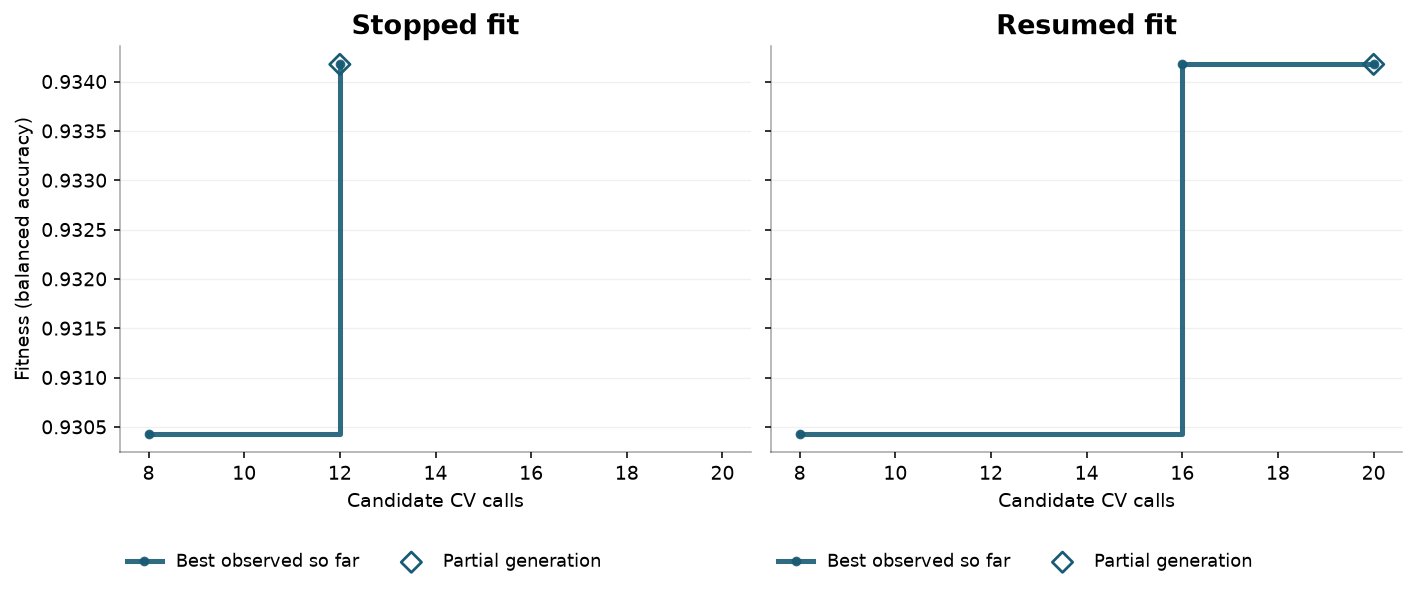
Hollow diamonds identify the partial generation in each fit. The resumed history starts from eight saved CV calls.
Use the diamond to identify a point based on a partial generation. The resumed history includes the saved calls and the new calls from the second fit. The checkpoint counters count fresh work in the most recent fit. Add the two fit_counts_["search_cv_calls"] values to obtain the work performed across both fits, including the work from the first partial generation. If the callback warns about serialization, the search continues from its current state. Only successfully written resumable checkpoints count as retained work. An existing file with an empty or unrecognized snapshot stops a new fit before candidate evaluation. Start an independent search with a new path. For an incomplete resumable optimizer snapshot, the error identifies the checkpoint path and missing fields.
Resume with shared Boolean folds
The search and finalist validation can share the same list of Boolean folds. A cloned estimator can hold separate copies of those arrays. The checkpoint compares their contents and order, so a resume can reuse the saved search results with either copy.
masked_template = clone(template).set_params(
    cv=masked_folds, final_selection_cv=masked_folds,
    final_selection="reuse_folds", final_selection_top_k=2, error_score="raise",
)
with TemporaryDirectory() as directory:
    checkpoint = ModelCheckpoint(Path(directory) / "masked-folds.pkl")
    clone(masked_template).fit(
        X_train, y_train, callbacks=[CVBudgetStopping(8), checkpoint]
    )
    saved_calls = checkpoint.load()["fit_stats"]["cross_validate_calls"]
    mask_resume = masked_template.fit(
        X_train, y_train, callbacks=[CVBudgetStopping(8), checkpoint]
    )
print("Saved search CV calls", saved_calls)
print("Fresh search CV calls", mask_resume.fit_counts_["search_cv_calls"])
print("Reused finalist scores", mask_resume.fit_counts_["finalist_reused_folds"])Saved search CV calls 8
Fresh search CV calls 8
Reused finalist scores 6Resume an exhausted DEAP search
Once a verified DEAP checkpoint holds scores for the entire finite search space, the search can restore the saved history and proceed with refitting. This example leaves finalist validation disabled and keeps the score cache.
deap_template = clone(imputation_search).set_params(optimizer_backend="deap")
with TemporaryDirectory() as directory:
    checkpoint = ModelCheckpoint(Path(directory) / "exhausted.pkl")
    first_fit = clone(deap_template).fit(X_train, y_train, callbacks=checkpoint)
    resumed_fit = clone(deap_template).fit(X_train, y_train, callbacks=checkpoint)
print("Search CV calls on resume", resumed_fit.fit_counts_["search_cv_calls"])
print("Generations before and after", first_fit.history["gen"], resumed_fit.history["gen"])
print("Full-data refits on resume", resumed_fit.fit_counts_["refit_fits"])Search CV calls on resume 0
Generations before and after [0] [0]
Full-data refits on resume 1Evaluate fresh proposals after resuming a covered space
A custom on_start callback can disable caching before evaluation starts. The saved candidates remain available. Coverage of their finite space allows the resumed engine to stop only while the cache is active. With caching disabled, the engine can score fresh proposals until another stopping rule applies.
from sklearn_genetic.callbacks import BaseCallback

class DisableCacheAtStart(BaseCallback):
    def on_start(self, estimator):
        estimator.use_cache = False

covered_template = clone(imputation_search)
with TemporaryDirectory() as directory:
    checkpoint = ModelCheckpoint(Path(directory) / "covered-space.pkl")
    clone(covered_template).fit(X_train, y_train, callbacks=checkpoint)
    fresh_resume = clone(covered_template).fit(
        X_train, y_train,
        callbacks=[DisableCacheAtStart(), CVBudgetStopping(10), checkpoint],
    )
print("Fresh search CV calls", fresh_resume.fit_counts_["search_cv_calls"])
print("Stopped on cached coverage", fresh_resume.search_space_exhausted_)Fresh search CV calls 10
Stopped on cached coverage FalsePlot generations with missing counts
Some older checkpoints have generation rows without a cumulative CV count. LivePlot(metrics=("cross_validate_calls",)) can follow a resumed search as soon as at least one generation supplies the count. The generation axis still includes earlier rows with missing values.
Use plot_generation_metrics for the same view of saved rows. Here the first row omits its count to illustrate a checkpoint written before that field was recorded.
from sklearn_genetic.plots import plot_generation_metrics

rows = [
    {"gen": generation, "cross_validate_calls": count}
    for generation, count in zip(
        resumed.history["gen"], resumed.history["cross_validate_calls"], strict=True
    )
]
rows[0].pop("cross_validate_calls")
plot_generation_metrics(rows, metrics=("cross_validate_calls",))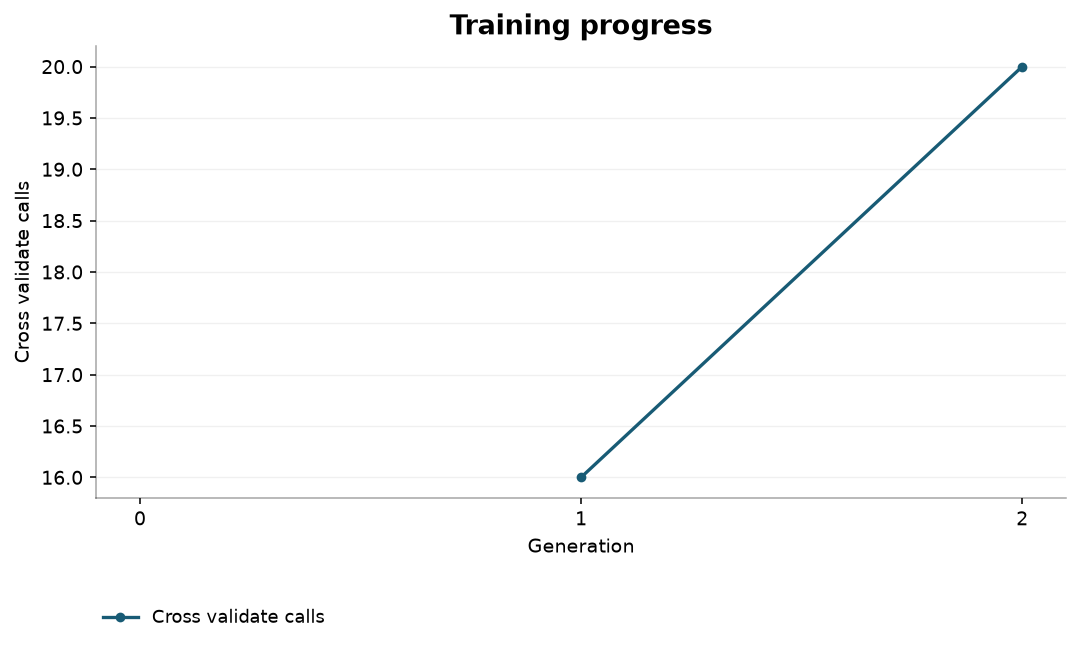
Generation 0 stays on the axis. The curve starts when the first CV count is available.
Configure a solver
The backend API lists supported settings. The following examples create configured estimators. Call fit as above to run them.
from functools import partial
from importlib.metadata import entry_points

engines = entry_points(group="sklearn_genetic.optimizers")
cma = clone(search).set_params(optimizer_backend=partial(engines["cmaes"].load(), sigma=0.15))
ng = clone(search).set_params(optimizer_backend=partial(engines["nevergrad"].load(), strategy="TwoPointsDE"))
ga = clone(selector).set_params(crossover_probability=0.7)
Use extended-precision scores with SciPy
SciPy compares double-precision losses. Two scores from a custom numpy.longdouble scorer can tie in the solver on platforms with extended precision. CV results, the candidate archive and finalist selection use the original score. Configure stop_on_convergence=False to continue through equal solver losses up to the search budget.
from sklearn_genetic.backends import scipy_optimizer

def closely_spaced_score(estimator, X, y):
    low = np.longdouble(1)
    return np.nextafter(low, np.longdouble(2)) if estimator.max_depth > 1 else low

precise_search = clone(search).set_params(
    optimizer_backend=scipy_optimizer(stop_on_convergence=False),
    param_grid={"max_depth": Integer(1, 3)}, scoring=closely_spaced_score,
    cv=2, population_size=8, generations=2, use_cache=False,
).fit(X_train, y_train)
print("Generations", precise_search.history["gen"])
print("Candidate CV calls", precise_search.fit_counts_["search_cv_calls"])
assert precise_search.best_score_ == precise_search.history["fitness_best_observed"][-1]Generations [0, 1, 2]
Candidate CV calls 24Run binary feature selection with CatCMAwM
CatCMAwM uses two categories per feature. The adapter builds the starting probabilities from the best initial masks and decodes each proposal in bulk. This example spends eight CV calls on initialization and eight on one new generation. It disables caching to make the observed budget explicit.
cma_selector = clone(selector).set_params(optimizer_backend="cmaes", use_cache=False)
cma_selector.fit(X_train, y_train, callbacks=CVBudgetStopping(16))
print("CV calls by generation", cma_selector.history["cross_validate_calls"])
print("Search fold fits", cma_selector.fit_counts_["search_fold_fits"])CV calls by generation [8, 16]
Search fold fits 48Use the CatCMAwM reference for supported coordinates and checkpoint behavior. When timing a wider feature search, keep the splits, seed and observed number of CV calls fixed.
Scale large losses in CatCMAwM
On numeric axes, CatCMAwM rescales large losses and its saved boundary penalty spreads before updating the distribution. This example uses a power-of-two scale outside the range of a Python float where NumPy supports it. Reported scores stay in the original units. The exponent is saved with the solver for checkpoint resume.
exponent = 2000 if np.finfo(np.longdouble).maxexp > 2000 else 1023

def large_loss(estimator, X, y):
    unit = np.longdouble(2 * estimator.ccp_alpha - 1)
    return np.ldexp(unit, exponent)

wide_search = clone(search).set_params(
    optimizer_backend="cmaes",
    param_grid={"ccp_alpha": Continuous(0.0, 1.0), "max_depth": Integer(2, 6)},
    scoring=large_loss, criteria="min", cv=2, population_size=8,
    generations=2, use_cache=False, error_score="raise",
    final_selection="reuse_folds", final_selection_top_k=2,
).fit(X_train, y_train)
print("Generations", wide_search.history["gen"])
print("Candidate CV calls", wide_search.fit_counts_["search_cv_calls"])
assert wide_search.best_score_ == wide_search.history["fitness_best_observed"][-1]Generations [0, 1, 2]
Candidate CV calls 24Plot extreme finalist scores
plot_finalist_scores uses the same scale for search CV and finalist CV. The horizontal axis gives the divisor when it rescales extreme finite scores. The star identifies the finalist selected for refit. Read final_selection_results_ for the scores in their original units.
from sklearn_genetic.plots import plot_finalist_scores

plot_finalist_scores(wide_search)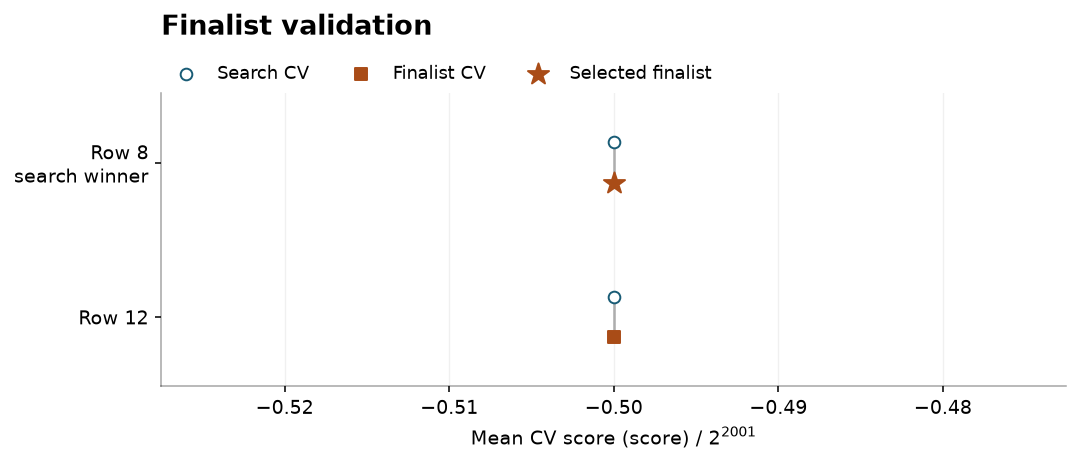
The plotted coordinates divide the original scores by the power of two in the axis label.
Plot extreme fitness over CV calls
This plot shows the best observed score and the population mean on one scale. It applies the divisor shown on the vertical axis before averaging the two-generation windows. The original scores remain in wide_search.history.
plot_fitness_evolution(
    wide_search, metrics=["fitness_best_observed", "fitness"], x="cv_calls", window=2
)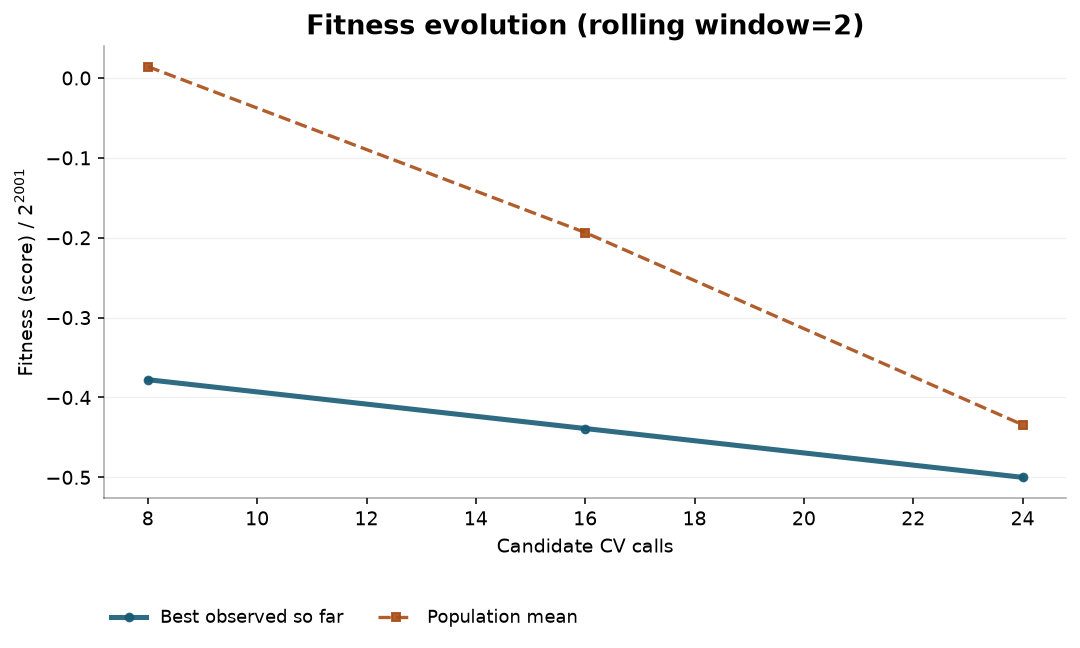
Both fitness series use the divisor in the vertical axis label.
Monitor extreme fitness during fitting
LivePlot uses the same vertical scale with generations on the horizontal axis. If a later generation changes the scale, the callback redraws earlier points on the same lines and updates the axis label. The fitted history keeps the original scores.
from matplotlib import pyplot as plt
from sklearn_genetic.plots import LivePlot

live = LivePlot(metrics=("fitness_best_observed", "fitness"))
monitored = clone(wide_search).fit(X_train, y_train, callbacks=live)
print("Plotted generations", list(live.ax.lines[0].get_xdata()))
assert monitored.history == wide_search.history
plt.close(live.ax.figure)Plotted generations [0, 1, 2]Route training and scoring weights to parallel candidates
Enable scikit-learn metadata routing while declaring the requests and calling fit. Each candidate worker inherits that configuration and receives the weights for its fold. Use separate requests when training and validation need different weights.
import numpy as np
from sklearn import config_context
from sklearn.metrics import accuracy_score, make_scorer

train_weights = np.where(y_train == 0, 2.0, 1.0)
score_weights = np.where(y_train == 0, 1.5, 1.0)
with config_context(enable_metadata_routing=True):
    weighted_model = clone(model).set_fit_request(sample_weight="train_weights")
    weighted_score = make_scorer(accuracy_score).set_score_request(
        sample_weight="score_weights"
    )
    weighted_search = clone(search).set_params(
        estimator=weighted_model, scoring=weighted_score, n_jobs=2,
        parallel_backend="population", generations=0,
    )
    weighted_search.fit(
        X_train, y_train, train_weights=train_weights, score_weights=score_weights
    )
print("Parallel batches", weighted_search.fit_stats_["population_parallel_batches"])
print("Weighted CV accuracy", round(weighted_search.best_score_, 3))Parallel batches 1
Weighted CV accuracy 0.924See the cross-validation guide for the same setup with feature selection and pipelines.
Route groups in nested cross-validation
Keep related observations together in the outer evaluation, the search and finalist validation. This example creates simulated groups for the built-in dataset. For repeated measurements, use the grouping units that match your evaluation, such as patients for both stages or sites for the outer split and patients for an inner split. Here the outer splitter requests its usual groups. The alias inner_groups provides the labels for the search and finalist splitters.
from sklearn.model_selection import GroupKFold, cross_validate
from sklearn.pipeline import make_pipeline

rows = np.arange(len(y_train))
groups = rows % 9
inner_groups = groups + 9 * (rows // 9 % 2)
with config_context(enable_metadata_routing=True):
    outer_cv = GroupKFold(3)
    grouped_search = clone(search).set_params(
        cv=GroupKFold(2), final_selection=True, final_selection_top_k=2,
        final_selection_cv=GroupKFold(3), population_size=4, generations=0,
    ).set_fit_request(groups="inner_groups")
    nested = cross_validate(
        make_pipeline(grouped_search), X_train, y_train, cv=outer_cv,
        scoring="balanced_accuracy",
        params={"groups": groups, "inner_groups": inner_groups},
        return_estimator=True, error_score="raise",
    )
print("Outer held-out scores", np.round(nested["test_score"], 3).tolist())
print("Finalist fold fits per outer split", [
    pipeline.steps[-1][1].fit_counts_["finalist_fold_fits"]
    for pipeline in nested["estimator"]
])Outer held-out scores [0.863, 0.947, 0.917]
Finalist fold fits per outer split [6, 6, 6]The outer scores evaluate the search and refit procedure on held-out groups. The finalist scores used to choose a configuration come from the outer training rows. Both GASearchCV and GAFeatureSelectionCV accept the group request shown here.
Select features inside a grouped pipeline
A feature selector can use GroupKFold as its search splitter and pass the selected columns to the final predictor. With metadata routing enabled, both the outer splitter and the selector's search splitter request groups. The outer validation passes only its training rows and their group labels to each pipeline fit.
grouped_selector = GAFeatureSelectionCV(
    model, cv=GroupKFold(2), scoring="balanced_accuracy", refit=False,
    population_size=4, generations=0, max_features=5,
    random_state=7, n_jobs=1, verbose=False,
)
with config_context(enable_metadata_routing=True):
    selected = cross_validate(
        make_pipeline(grouped_selector, model), X_train, y_train,
        cv=GroupKFold(3), scoring="balanced_accuracy",
        params={"groups": groups}, return_estimator=True, error_score="raise",
    )
print("Outer held-out scores", np.round(selected["test_score"], 3).tolist())
print("Search folds per outer split", [
    pipeline.steps[0][1].n_splits_ for pipeline in selected["estimator"]
])Outer held-out scores [0.895, 0.88, 0.917]
Search folds per outer split [2, 2, 2]Route groups to feature finalists
Set a group-aware final_selection_cv when only the finalist stage needs group labels. With metadata routing enabled, the ordinary groups parameter reaches both the outer splitter and the selector's finalist splitter. The search uses its own CV policy.
finalist_selector = GAFeatureSelectionCV(
    model, cv=2, scoring="balanced_accuracy",
    final_selection=True, final_selection_cv=GroupKFold(2),
    final_selection_top_k=2, population_size=4, generations=0,
    max_features=5, random_state=7, n_jobs=1, verbose=False,
)
with config_context(enable_metadata_routing=True):
    grouped_finalists = cross_validate(
        make_pipeline(finalist_selector, clone(model)), X_train, y_train,
        cv=GroupKFold(3), scoring="balanced_accuracy", params={"groups": groups},
        return_estimator=True, error_score="raise",
    )
print("Outer held-out scores", np.round(grouped_finalists["test_score"], 3).tolist())
print("Finalist fold fits per outer split", [
    pipeline.steps[0][1].fit_counts_["finalist_fold_fits"]
    for pipeline in grouped_finalists["estimator"]
])Outer held-out scores [0.895, 0.88, 0.917]
Finalist fold fits per outer split [4, 4, 4]Combine grouped search with a custom finalist splitter
If your custom splitter implements split(X, y), it can supply folds for one stage while a group-aware splitter receives groups in the other. In this example, the finalist splitter returns group-disjoint folds prepared from the training partition before fitting.
class PresetFolds:
    def __init__(self, folds):
        self.folds = folds

    def split(self, X, y):
        return iter(self.folds)

finalist_folds = list(GroupKFold(3).split(X_train, y_train, groups=groups))
mixed_search = clone(search).set_params(
    cv=GroupKFold(2), final_selection=True, final_selection_top_k=2,
    final_selection_cv=PresetFolds(finalist_folds),
    population_size=4, generations=0,
).fit(X_train, y_train, groups=groups)
print("Search folds", mixed_search.n_splits_)
print("Finalist fold fits", mixed_search.fit_counts_["finalist_fold_fits"])Search folds 2
Finalist fold fits 6Inspect candidates that fail all CV folds
This search tries one valid tree depth and one invalid depth. With numeric error_score, the invalid candidate issues a warning and the search can still return a fitted model. Select the Boolean all_fits_failed column to identify rows whose estimator failed to fit every fold.
import warnings
from sklearn.exceptions import FitFailedWarning

depths = clone(search).set_params(
    param_grid={"max_depth": Categorical([0, 3]), "criterion": Categorical(["gini"])},
    warm_start_configs=[{"max_depth": 0, "criterion": "gini"},
                        {"max_depth": 3, "criterion": "gini"}],
    population_size=2, generations=0, n_jobs=1, error_score=float("nan"),
)
with warnings.catch_warnings(record=True) as recorded:
    warnings.simplefilter("always", FitFailedWarning)
    depths.fit(X_train, y_train)
print("Emitted FitFailedWarning:",
      any(issubclass(item.category, FitFailedWarning) for item in recorded))
rows = depths.cv_results_dataframe(
    columns=["param_max_depth", "mean_test_score", "all_fits_failed"],
    preserve_index=True,
)
print(rows.loc[rows["all_fits_failed"]].reset_index().to_string(index=False))Emitted FitFailedWarning: True
candidate_index param_max_depth mean_test_score all_fits_failed
0 0 NaN TrueA partial fit failure or a scorer returning NaN after fitting leaves all_fits_failed false. Use the split score columns and warnings to investigate those cases. The flag describes each candidate row, including reused results.
With numeric error_score, the search keeps the report even if every candidate fails. Catch the search error to inspect the parameters and fold diagnostics. Both failed rows share rank 1 because they tie.
invalid_depths = clone(depths).set_params(
    param_grid={"max_depth": Categorical([0, -1])},
    warm_start_configs=[{"max_depth": 0}, {"max_depth": -1}],
)
with warnings.catch_warnings(record=True) as recorded:
    warnings.simplefilter("always", FitFailedWarning)
    try:
        invalid_depths.fit(X_train, y_train)
    except ValueError as error:
        if not str(error).startswith("All search candidates failed to fit."):
            raise
        print(error)
    else:
        raise AssertionError("Expected every candidate to fail")
print(invalid_depths.cv_results_dataframe(
    columns=["param_max_depth", "all_fits_failed", "rank_test_score"],
    preserve_index=True,
).reset_index().to_string(index=False))
print("Attempted fold fits", invalid_depths.fit_counts_["search_fold_fits"])All search candidates failed to fit. Set error_score='raise' to debug.
candidate_index param_max_depth all_fits_failed rank_test_score
0 0 True 1
1 -1 True 1
Attempted fold fits 6For feature selection, skipped_invalid_mask marks rows that never reached CV. If every attempted mask fails, the selector raises before finalist validation or refitting and keeps both flags in cv_results_. See CV troubleshooting.
Inspect an optimizer error
Set error_score="raise" to surface the original estimator error. Read search_time_ after catching it to see how long the optimizer ran. fit_counts_ keeps the CV work recorded up to the error.
fail_fast = clone(depths).set_params(error_score="raise")
try:
    fail_fast.fit(X_train, y_train)
except ValueError as error:
    if "max_depth" not in str(error):
        raise
    print(type(error).__name__)
    print(f"Elapsed search time: {fail_fast.search_time_:.3g} seconds")
else:
raise AssertionError("Expected the invalid depth to raise")InvalidParameterError
Elapsed search time: 0.00101 secondsThis callback raises after one completed generation. The example prints the recorded CV calls and fold fits. The count plot marks search work as a lower bound because work in an interrupted CV call can go unreported.
from sklearn_genetic.callbacks import BaseCallback

class FailAfterFirstReport(BaseCallback):
    def on_step(self, record=None, logbook=None, estimator=None):
        raise RuntimeError("example stops after one generation")

interrupted_search = clone(search).set_params(population_size=6, generations=1)
try:
    interrupted_search.fit(X_train, y_train, callbacks=FailAfterFirstReport())
except RuntimeError as error:
    if str(error) != "example stops after one generation":
        raise
else:
    raise AssertionError("Expected the report callback to raise")

print("Search interrupted", interrupted_search.search_interrupted_)
print("Recorded CV calls", interrupted_search.fit_counts_["search_cv_calls"])
print("Recorded fold fits", interrupted_search.fit_counts_["search_fold_fits"])Search interrupted True
Recorded CV calls 6
Recorded fold fits 18A failure inside a batch can leave completed evaluations that have already returned their scores. This scorer raises on the seventh fold, after two three-fold candidate evaluations finish. fit_counts_ includes those two evaluations. fit_stats_ tracks published search counters, and a checkpoint resumes its saved search state.
scored_folds = []

def score_until_batch_error(estimator, X, y):
    scored_folds.append(len(y))
    if len(scored_folds) == 7:
        raise RuntimeError("example interrupts the third candidate")
    return balanced_accuracy_score(y, estimator.predict(X))

interrupted_batch = clone(search).set_params(
    cv=3, population_size=6, generations=0, scoring=score_until_batch_error,
    error_score="raise", use_cache=False, n_jobs=1,
)
try:
    interrupted_batch.fit(X_train, y_train)
except RuntimeError as error:
    if str(error) != "example interrupts the third candidate":
        raise
else:
    raise AssertionError("Expected the scorer to interrupt the batch")

print("Confirmed CV calls", interrupted_batch.fit_counts_["search_cv_calls"])
print("Confirmed fold fits", interrupted_batch.fit_counts_["search_fold_fits"])
print("Recorded CV calls", interrupted_batch.fit_stats_["cross_validate_calls"])Confirmed CV calls 2
Confirmed fold fits 6
Recorded CV calls 0With parallel_backend="population" and the built-in worker threads, a later proposal can finish while the optimizer is waiting for an earlier one that raises. The fit-work count includes those completed CV calls once the workers have shut down. It remains a lower bound on fold fits because a failing candidate can run folds before its evaluation raises. If batch preparation or result recording raises, fit_counts_ includes the completed CV calls from that batch once each. See the fit-work counters.
Inspect finalist validation without a winner
This example makes the scorer return NaN on the smaller validation partitions from four-fold finalist CV. The initial three-fold search still produces finite scores. Catch the validation error to inspect the recorded finalists and their split scores.
def score_with_minimum_validation_size(estimator, X, y):
    if len(y) < len(y_train) // 3:
        return float("nan")
    return balanced_accuracy_score(y, estimator.predict(X))

failed_finalists = clone(search).set_params(
    scoring=score_with_minimum_validation_size, final_selection=True,
    final_selection_cv=4, final_selection_top_k=2,
    population_size=4, generations=0, error_score="raise",
)
try:
    failed_finalists.fit(X_train, y_train)
except ValueError as error:
    if str(error) != "All final-selection candidates produced non-finite scores":
        raise
    print(error)
else:
    raise AssertionError("Expected the finalist scores to be non-finite")

diagnostics = failed_finalists.final_selection_results_
print("Completed finalists", len(diagnostics["candidates"]))
print("Selected index", diagnostics["selected_index"])
print("Finalist fold fits", failed_finalists.fit_counts_["finalist_fold_fits"])
print("Per-fold scores", diagnostics["candidates"][0]["cv_scores"])All final-selection candidates produced non-finite scores
Completed finalists 2
Selected index None
Finalist fold fits 8
Per-fold scores [nan, nan, nan, nan]from sklearn_genetic.plots import plot_finalist_scores
plot_finalist_scores(failed_finalists)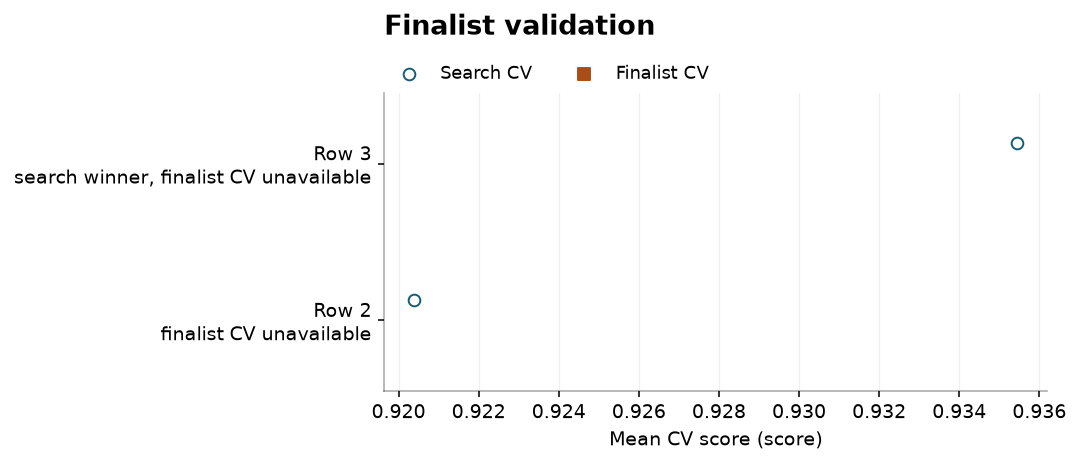
Search scores remain visible for both finalists.
Inspect an interrupted finalist
An exception can stop a finalist partway through its folds. This controlled scorer lets the first finalist finish and raises on the second fold of the next finalist. Use one worker so the order of the calls is reproducible. The interrupted CV call counts toward the work of the fit. The fold count uses completed CV calls, since the exception does not report how many folds ran in the interrupted call.
finalist_scores_seen = []

def score_until_interrupted(estimator, X, y):
    if len(y) < len(y_train) // 3:
        finalist_scores_seen.append(len(y))
        if len(finalist_scores_seen) == 6:
            raise RuntimeError("example interrupts the second finalist")
    return balanced_accuracy_score(y, estimator.predict(X))

interrupted = clone(failed_finalists).set_params(scoring=score_until_interrupted, n_jobs=1)
try:
    interrupted.fit(X_train, y_train)
except RuntimeError as error:
    if str(error) != "example interrupts the second finalist":
        raise
else:
    raise AssertionError("Expected an interrupted finalist")

work = interrupted.fit_counts_
failure = interrupted.final_selection_results_["failed_candidate"]
print("Finalist CV calls", work["finalist_cv_calls"])
print("Known finalist fold fits", work["finalist_fold_fits"])
print("Interrupted candidate row", failure["index"])
print("CV calls for that row", failure["cv_calls"])Finalist CV calls 2
Known finalist fold fits 4
Interrupted candidate row 2
CV calls for that row 1Earlier finalist results are available in interrupted.final_selection_results_["candidates"]. The finalist score plot labels the interrupted row and shows its search score. This also works when validation stops on the first finalist.
plot_finalist_scores(interrupted)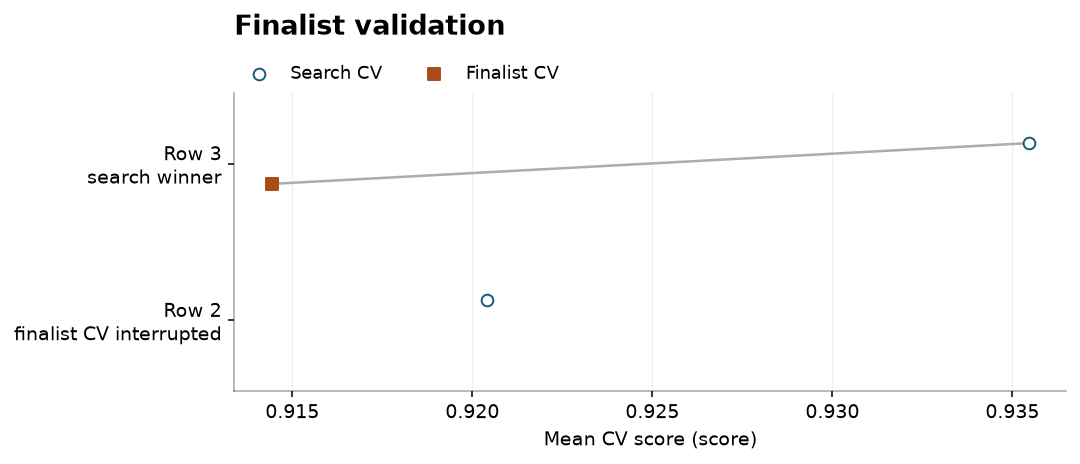
The interrupted row shows its search CV score. The earlier finalist shows scores from both stages.
The fit-work plot marks the known finalist fold count with ≥.
from sklearn_genetic.plots import plot_fit_work

plot_fit_work(interrupted)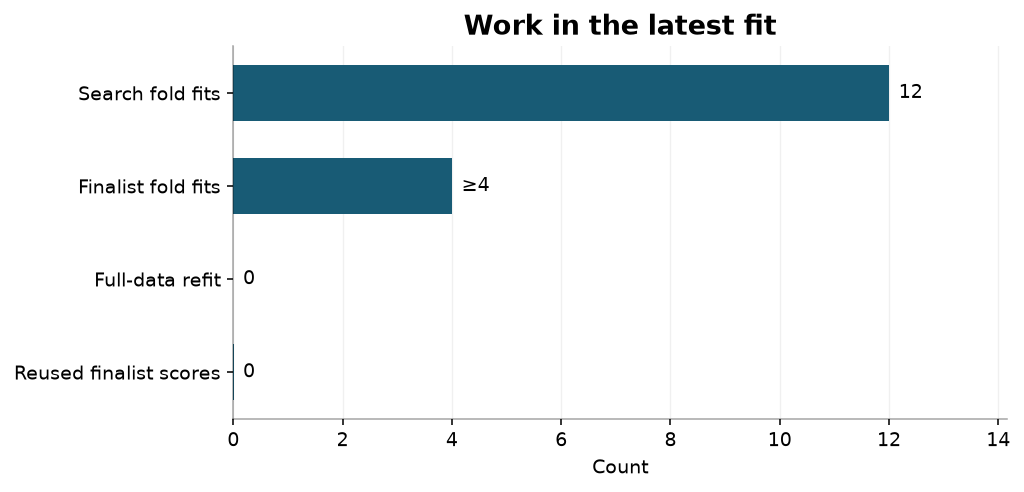
Four finalist fold fits are confirmed. The interrupted CV call may have run further folds.
In seconds mode, the same plot labels Finalist validation (failed) and shows the elapsed time recorded in the failed phase. The status is also available as final_selection_results_["failed"].
plot_fit_work(interrupted, unit="seconds")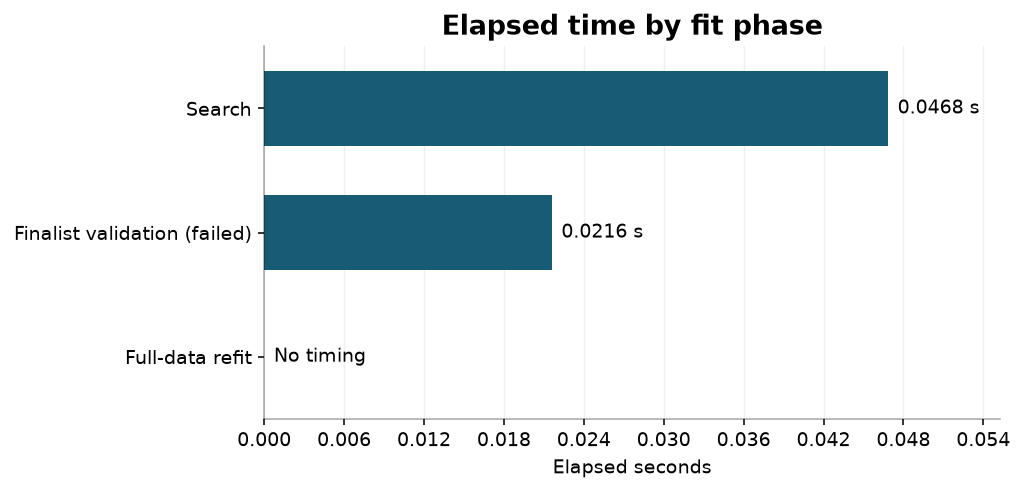
The finalist validation bar shows time spent before the exception.
Inspect a failed full-data refit
The estimator in this example accepts the smaller CV training folds and raises when it receives the full training set. After catching the error, read refit_failure_time_ to see how long the refit phase ran. The fit-work plot labels this phase Full-data refit (failed).
class RejectFullTrainingSet(DecisionTreeClassifier):
    def fit(self, X, y, **fit_params):
        if len(y) == len(y_train):
            raise ValueError("example rejects the full training set")
        return super().fit(X, y, **fit_params)

failed_refit = clone(search).set_params(
    estimator=RejectFullTrainingSet(random_state=7),
    population_size=2, generations=0, n_jobs=1, error_score="raise",
)
try:
    failed_refit.fit(X_train, y_train)
except ValueError as error:
    if str(error) != "example rejects the full training set":
        raise
    print(error)
else:
    raise AssertionError("Expected the full-data refit to raise")

print("Completed refits", failed_refit.fit_counts_["refit_fits"])
print("Elapsed time recorded", failed_refit.refit_failure_time_ >= 0)
elapsed_refit = plot_fit_work(failed_refit, unit="seconds")
print(elapsed_refit.get_yticklabels()[-1].get_text())
plt.close(elapsed_refit.figure)example rejects the full training set
Completed refits 0
Elapsed time recorded True
Full-data refit (failed)Diagnose an undefined objective
Here the objective scorer returns NaN on every fold and a second scorer still reports accuracy. The search warns about the objective once and keeps both sets of CV results. Use the split scores to see where the objective is undefined.
def unavailable(estimator, X, y):
    return float("nan")

report_only = clone(search).set_params(
    scoring={"unavailable": unavailable, "accuracy": "accuracy"},
    objective_metric="unavailable", refit=False,
    population_size=2, generations=0,
)
with warnings.catch_warnings(record=True) as recorded:
    warnings.simplefilter("always", UserWarning)
    report_only.fit(X_train, y_train)
for warning in recorded:
    if str(warning.message).startswith("No candidate has a finite mean CV score"):
        print(warning.message)
print("First candidate accuracy", round(report_only.cv_results_["mean_test_accuracy"][0], 3))No candidate has a finite mean CV score for the objective metric 'unavailable'. Inspect the split scores in cv_results_.
First candidate accuracy 0.911Configure a combined scorer
A standalone callable returns one number per fold. A callable returning several metrics raises a configuration error. Supply the scorers by name to record each metric and choose the objective through refit.
def combined_score(estimator, X, y):
    prediction = estimator.predict(X)
    return {"accuracy": accuracy_score(y, prediction),
            "balanced_accuracy": balanced_accuracy_score(y, prediction)}

probe = clone(search).set_params(scoring=combined_score, population_size=4, generations=0)
try:
    probe.fit(X_train, y_train, callbacks=CVBudgetStopping(1))
except ValueError as error:
    print(error)
else:
    raise AssertionError("Expected the combined scorer to raise")

named = clone(probe).set_params(
    scoring={"accuracy": "accuracy", "balanced_accuracy": "balanced_accuracy"},
    refit="balanced_accuracy",
)
named.fit(X_train, y_train, callbacks=CVBudgetStopping(1))
print("Recorded metrics:", list(named.scorer_))A callable passed as scoring must return a single numeric score per fold. Pass a dictionary of named scorers to scoring for multiple metrics.
INFO: Stopping the algorithm
Recorded metrics: ['accuracy', 'balanced_accuracy']Inspect parameters with names shared by CV diagnostics
A custom estimator can have a constructor parameter named fit_time. param_fit_time keeps that parameter, while mean_fit_time reports the measured time across folds. The final refit uses the stored parameter value. For this single-parameter grid, the search builds both the parameter column and the candidate dictionaries from the same ordered values.
class TreeWithCustomParameter(DecisionTreeClassifier):
    def __init__(self, fit_time=2):
        super().__init__(random_state=7)
        self.fit_time = fit_time

    def fit(self, X, y, sample_weight=None, check_input=True):
        self.max_depth = self.fit_time
        return super().fit(X, y, sample_weight=sample_weight, check_input=check_input)

custom = GASearchCV(
    TreeWithCustomParameter(), param_grid={"fit_time": Integer(2, 6)},
    cv=folds, population_size=4, generations=0, random_state=7, verbose=False,
).fit(X_train, y_train)
print("Candidate parameters", custom.cv_results_["param_fit_time"])
assert custom.cv_results_["param_fit_time"] == [
    row["fit_time"] for row in custom.cv_results_["params"]
]
print("Refitted parameter", custom.best_estimator_.fit_time)
print("Recorded timing for each candidate",
len(custom.cv_results_["mean_fit_time"]) == len(custom.cv_results_["params"]))Candidate parameters [2, 3, 4, 6]
Refitted parameter 3
Recorded timing for each candidate TrueUse the param_* columns when plotting a parameter that shares a name with a diagnostic. Here one column shows the estimator parameter and the other shows its mean validation score.
from sklearn_genetic.plots import plot_search_space

plot_search_space(
    custom, features=["param_fit_time", "mean_test_score"], kind="heatmap"
)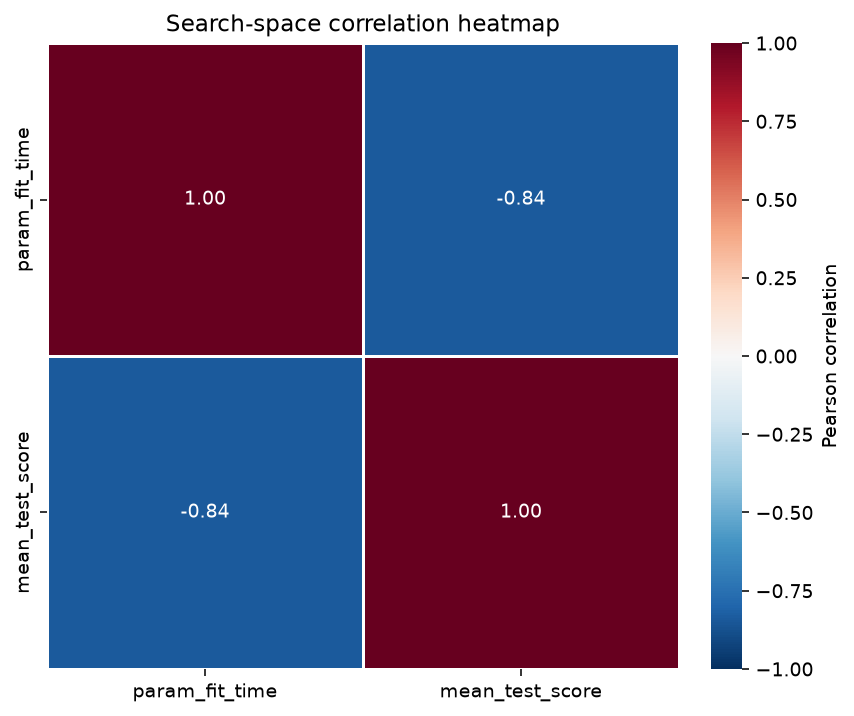
The parameter column uses the values supplied to the estimator.