
Development version
This is the latest (dev) documentation. It may contain unreleased features or breaking changes. For the stable release, use stable.
Tuning CatBoost With GASearchCV
CatBoost uses ordered boosting and symmetric trees, which makes its tuning knobs different from XGBoost and LightGBM: depth controls the symmetric tree size, l2_leaf_reg and random_strength regularize, bagging_temperature controls Bayesian bootstrap aggressiveness, and border_count sets the feature-discretization resolution. This tutorial searches that space with GASearchCV and shows the real gain over CatBoost's defaults.
Prerequisites
pip install sklearn-genetic-opt catboostA Noisy Dataset
import warnings
import time

import numpy as np
import pandas as pd
from catboost import CatBoostClassifier
from sklearn.datasets import make_classification
from sklearn.metrics import accuracy_score, balanced_accuracy_score, roc_auc_score
from sklearn.model_selection import StratifiedKFold, train_test_split

from sklearn_genetic import (
    EvolutionConfig,
    GASearchCV,
    OptimizationConfig,
    PopulationConfig,
    RuntimeConfig,
)
from sklearn_genetic.callbacks import ConsecutiveStopping, TimerStopping
from sklearn_genetic.schedules import ExponentialAdapter, InverseAdapter
from sklearn_genetic.space import Continuous, Integer

warnings.filterwarnings("ignore")
RANDOM_STATE = 42

X, y = make_classification(
    n_samples=2500, n_features=30, n_informative=8, n_redundant=8,
    n_clusters_per_class=3, class_sep=0.6, flip_y=0.08, random_state=RANDOM_STATE,
)
X_train, X_test, y_train, y_test = train_test_split(
    X, y, test_size=0.40, stratify=y, random_state=RANDOM_STATE
)
cv = StratifiedKFold(n_splits=3, shuffle=True, random_state=RANDOM_STATE)
print(f"train={X_train.shape} test={X_test.shape}")train=(1500, 30) test=(1000, 30)Baseline: CatBoost Defaults
CatBoost manages its own threads; we set thread_count=1 and verbose=0. We cap iterations so the baseline trains quickly.
def make_catboost(**kwargs):
    params = dict(thread_count=1, verbose=0, random_state=RANDOM_STATE,
                  allow_writing_files=False)
    params.update(kwargs)
    return CatBoostClassifier(**params)


def evaluate(name, estimator):
    proba = estimator.predict_proba(X_test)[:, 1]
    pred = estimator.predict(X_test)
    return {
        "model": name,
        "accuracy": round(accuracy_score(y_test, pred), 4),
        "balanced_accuracy": round(balanced_accuracy_score(y_test, pred), 4),
        "roc_auc": round(roc_auc_score(y_test, proba), 4),
    }


baseline = make_catboost(iterations=300)
baseline.fit(X_train, y_train)
baseline_metrics = evaluate("CatBoost defaults", baseline)
print(baseline_metrics){'model': 'CatBoost defaults', 'accuracy': 0.805, 'balanced_accuracy': 0.8049, 'roc_auc': 0.8803}Search Space
Seven CatBoost-specific parameters. border_count (feature binning resolution) and bagging_temperature (bootstrap aggressiveness) interact with depth and l2_leaf_reg to control over/under-fitting.
param_grid = {
    "iterations":          Integer(100, 350),
    "depth":               Integer(3, 10),
    "learning_rate":       Continuous(0.01, 0.3, distribution="log-uniform"),
    "l2_leaf_reg":         Continuous(1.0, 30.0, distribution="log-uniform"),
    "bagging_temperature": Continuous(0.0, 1.0),
    "random_strength":     Continuous(1e-3, 10.0, distribution="log-uniform"),
    "border_count":        Integer(32, 255),
}
Configure and Run
ga_search = GASearchCV(
    estimator=make_catboost(),
    random_state=RANDOM_STATE,
    param_grid=param_grid,
    scoring="roc_auc",
    cv=cv,
    evolution_config=EvolutionConfig(
        population_size=10,
        generations=8,
        crossover_probability=ExponentialAdapter(initial_value=0.8, end_value=0.4, adaptive_rate=0.15),
        mutation_probability=InverseAdapter(initial_value=0.25, end_value=0.05, adaptive_rate=0.20),
        elitism=True,
        keep_top_k=3,
    ),
    population_config=PopulationConfig(
        initializer="smart",
        warm_start_configs=[{
            "iterations": 300, "depth": 6, "learning_rate": 0.1,
            "l2_leaf_reg": 3.0, "bagging_temperature": 1.0,
            "random_strength": 1.0, "border_count": 254,
        }],
    ),
    runtime_config=RuntimeConfig(n_jobs=-1, parallel_backend="cv",
                                 use_cache=True, verbose=False),
    optimization_config=OptimizationConfig(
        diversity_control=True, fitness_sharing=True,
        local_search=True, local_search_top_k=2,
    ),
)

callbacks = [
    ConsecutiveStopping(generations=5, metric="fitness_best"),
    TimerStopping(total_seconds=90),
]
started = time.perf_counter()
ga_search.fit(X_train, y_train, callbacks=callbacks)
ga_seconds = time.perf_counter() - started

print(f"Best CV ROC AUC : {ga_search.best_score_:.4f}   (search took {ga_seconds:.0f}s)")
print("Best parameters :")
for key, value in ga_search.best_params_.items():
print(f" {key}: {value}")INFO: TimerStopping callback met its criteria
INFO: Stopping the algorithm
Best CV ROC AUC : 0.8658 (search took 189s)
Best parameters :
iterations: 225
depth: 9
learning_rate: 0.027578370077838747
l2_leaf_reg: 14.189626805239074
bagging_temperature: 0.9841953273239505
random_strength: 0.01972533036679783
border_count: 196Baseline vs Tuned
ga_metrics = evaluate("GASearchCV (tuned)", ga_search)
comparison = pd.DataFrame([baseline_metrics, ga_metrics])
print(comparison.to_string(index=False))
print()
print(f"ROC AUC improvement over defaults: "
f"{ga_metrics['roc_auc'] - baseline_metrics['roc_auc']:+.4f}") model accuracy balanced_accuracy roc_auc
CatBoost defaults 0.805 0.8049 0.8803
GASearchCV (tuned) 0.803 0.8029 0.8875
ROC AUC improvement over defaults: +0.0072Fitness over generations
import matplotlib.pyplot as plt

history = pd.DataFrame(ga_search.history)
fig, ax = plt.subplots(figsize=(9, 4))
ax.plot(history["gen"], history["fitness_best"], marker="o", label="best so far", color="#8e44ad")
ax.plot(history["gen"], history["fitness"], marker=".", label="generation mean", color="#95a5a6")
ax.set_xlabel("Generation")
ax.set_ylabel("CV ROC AUC")
ax.set_title("CatBoost genetic search — fitness over generations")
ax.legend(frameon=False)
ax.grid(alpha=0.25)
fig.tight_layout()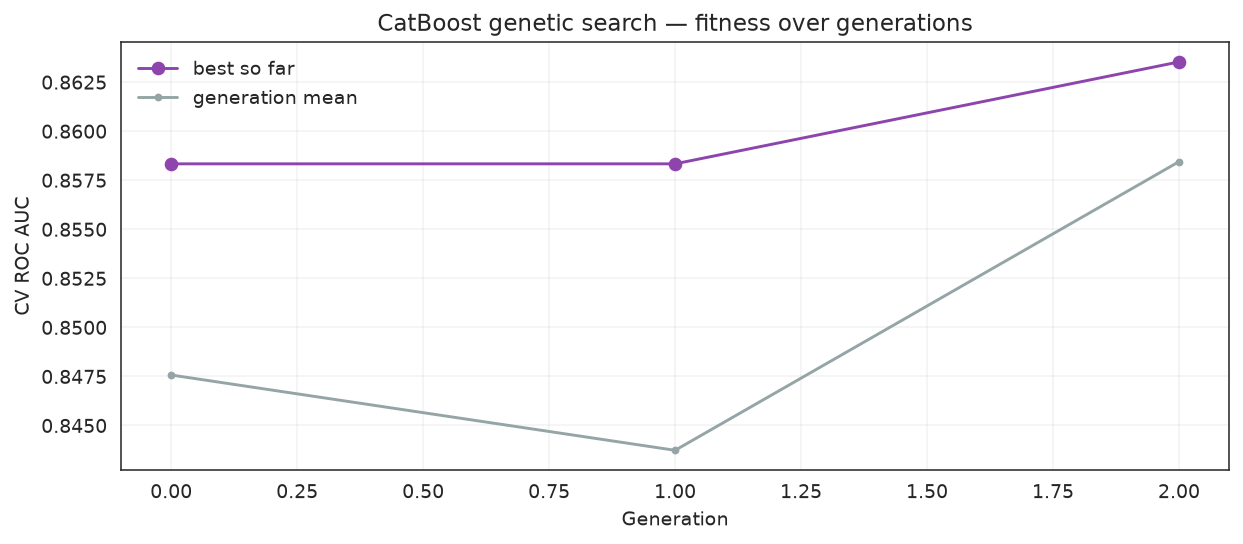
Practical Notes
- Set
allow_writing_files=Falseto stop CatBoost from littering the working directory with training logs. - Pair
thread_count=1withparallel_backend="cv"to avoid CPU oversubscription. border_countrarely needs to exceed 254; higher values cost time for little gain.l2_leaf_regandrandom_strengthare the main regularizers.- The headline win is tuning vs the default model on noisy data.